
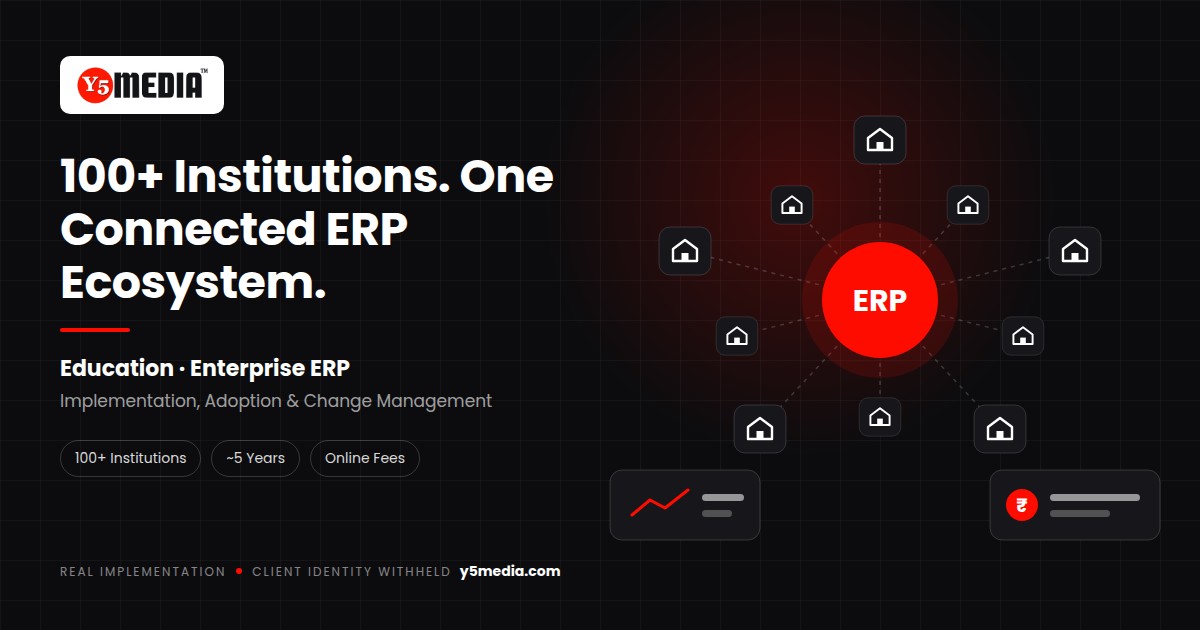
Real Implementation. Client identity withheld. This case study describes an actual ERP implementation delivered by Y5MEDIA. The institution is a well-known education organisation; its identity and identifying details have been withheld for confidentiality.
Industry: Education. Project: Enterprise ERP Implementation. Scale: 100+ Decentralised Institutions. Timeline: Approximately 5 Years
At a glance: A well-known education organisation with 100+ decentralised institutions set out to connect its entire network through one ERP ecosystem. Over approximately five years, the platform grew from a complex technology implementation into everyday operating infrastructure, with online fee collection, accounting and reconciliation, and institution-wise data segregation. The biggest lesson: software is not the hardest part of ERP. People, data and coordination are.
The Background
A well-known education institution with 100+ decentralised institutions operating under one main organisation embarked on an ambitious digital transformation project.
The objective was straightforward:
Connect the entire network through a unified ERP ecosystem while allowing individual institutions to continue managing their own operations.
But turning that vision into reality required far more than developing software.
The Real Challenge Was People + Data + Coordination
The project required information to be collected from staff across a large decentralised network.
One of the biggest bottlenecks was the dependence on a single point of coordination for gathering and consolidating the required information from different teams. The person responsible was effectively an information gatekeeper between the implementation team and the wider institution network.
There were multiple challenges:
- Information was coming from different departments.
- Data was not always available in a standard format.
- Requirements changed during the process.
- Staff needed repeated clarification and training.
- Coordination between teams was difficult.
- Some stakeholders were hesitant about the proposed changes.
- There was resistance to moving away from existing processes.
- The implementation team sometimes had to wait for information before development could proceed.
The Result?
The project moved slower than originally expected.
The delay wasn’t simply a software-development problem. It was a people, data, coordination and change-management problem.
When People Resist Change
Introducing one ERP across 100+ institutions meant changing established ways of working. Not everyone welcomed the change immediately.
- Some people preferred existing processes.
- Some were concerned about new responsibilities.
- Others were uncomfortable with increased transparency and standardisation.
This created another layer of complexity:
Building the software was only half the job. The other half was getting people to use it.
The Y5MEDIA Implementation Approach
The project required continuous coordination between the development team, management, administrators, accountants, staff and individual institutions. The implementation involved:
01 – Data Collection
Gathering information from multiple institutions and departments.
02 – Data Standardisation
Organising inconsistent information into a structured ERP framework.
03 – System Development
Developing and adapting modules according to operational requirements.
04 – Training
Helping staff understand and adopt the new workflows.
05 – Institution-wise Segregation
Maintaining appropriate separation of institutional data while operating within one larger ecosystem.
06 – Payment Integration
Connecting online payment gateways to support digital fee collection.
07 – Accounting & Reconciliation
Connecting operational transactions with financial workflows.
08 – Continuous Support
Resolving issues, improving workflows and supporting users after deployment.
Five Years of Real-World Learning
ERP systems reveal their real strengths and weaknesses only after years of actual use. Over approximately five years, the platform encountered:
- Bugs
- New requirements
- Changing workflows
- User challenges
- Data issues
- Integration requirements
- Support requests
- Accounting and reconciliation challenges
Every issue became feedback for the next improvement.
The system evolved. The users evolved. And the organisation’s ability to manage the platform evolved with it.
From Dependency to Confidence
One of the most important outcomes was not simply the number of ERP features. It was the gradual reduction of dependency on external intervention.
After years of:
Training → Usage → Problems → Support → Improvements → Re-training → Stabilisation
the institutions became increasingly comfortable managing the system themselves.
What was once a complicated technology implementation became part of the organisation’s daily operating infrastructure.
Online Fee Collection
One of the major capabilities introduced was online fee payment. Parents can pay fees digitally through the integrated payment system. This connects:
PARENT → PAYMENT GATEWAY → ERP → ACCOUNTS → RECONCILIATION
Instead of treating payment collection and accounting as separate processes, the ERP brings them into a connected workflow.
Central Control. Decentralised Operations.
The organisation needed both central visibility and institution-level control.
The ERP provides a framework where multiple institutions can operate within the larger ecosystem while maintaining appropriate institution-wise data and operational segregation.
This allows the main organisation to maintain visibility without forcing every institution into completely independent systems.
Today
After approximately five years of real-world use, the platform has matured into a comprehensive ERP ecosystem supporting a large decentralised education network. The system now supports capabilities including:
- ✔ Institution Management
- ✔ Student & Parent Management
- ✔ Online Fee Collection
- ✔ Payment Gateway Integration
- ✔ Accounting & Reconciliation
- ✔ Data Segregation
- ✔ Reporting & Analytics
- ✔ User Management
- ✔ Operational Workflows
- ✔ Technical Support
- ✔ Scalable Multi-Institution Management
The Biggest Lesson
Software is not the hardest part of ERP.
The difficult part is getting:
- 100+ institutions
- hundreds of users
- different departments
- different workflows
- different expectations
- different levels of technical knowledge
to work together around one system.
Five years later, the project demonstrates an important reality:
Digital transformation doesn’t happen when software is installed. It happens when people finally learn to work with it.
Case Study Status
Real Implementation – Client Identity Withheld. The institution is a well-known education organisation. Its identity and identifying details have been withheld for confidentiality.