
Real Implementation. This case study is based on a real project and a real incident from my professional journey. The names and identifying details have been intentionally omitted.
Case Study | Client & Project Management. Industry: Sports media. For: Freelancers, consultants, agencies and anyone managing client projects
At a glance: A well-known GCC businessman set out to build a sports media association with a portal, digital magazine, branding and social media presence. The vision was strong, but shifting decisions, delayed payments and internal team politics stalled the work. This is what went wrong, why I eventually walked away, and the rules I now set before starting any serious project.
When a Great Vision Meets Poor Execution
A real-life case study on clients, payments, team politics and knowing when to walk away.
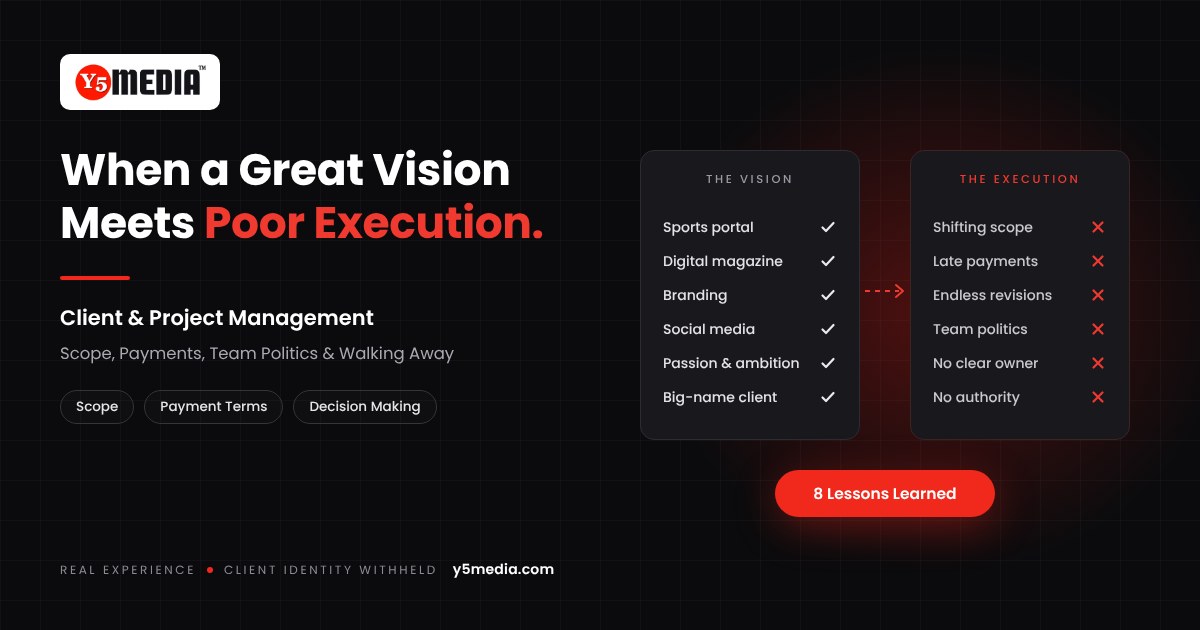
Around four years ago, I had the opportunity to work with a well-known businessman from the GCC. He had a genuine passion for sports and was already involved with a sports association. His ambition was to build something much bigger: a dedicated sports media association, supported by a professional sports portal, digital magazine, branding, social media presence, and other digital assets.
On paper, the vision was impressive.
The opportunity also looked exciting to me because it allowed me to work across multiple areas rather than being restricted to a single role.
I eventually found myself handling almost everything:
- Website design and development
- Sports portal management
- Magazine and publication design
- Branding and visual materials
- System and technical maintenance
- Social media management
- Digital operations
- General technology support
In many ways, I became the “one person who could handle everything.”
The compensation, however, was considerably lower than what such a broad responsibility normally justified. At that stage of my career, I accepted it partly because I valued the experience, exposure and opportunity to learn.
Initially, things appeared to be moving in the right direction.
Then the real problems started.
The Problem Wasn’t the Vision
The biggest lesson from this experience is that a good vision does not automatically produce a good business.
The vision was there. The passion was there. The ambition was there.
But the execution environment was weak.
There were several people involved in the project, and instead of everyone working toward the same objective, internal relationships, community considerations, personal insecurities and territorial behaviour started influencing decisions.
At times, the problem wasn’t technology. It wasn’t design. It wasn’t the lack of ideas.
It was the people and the way decisions were being made.
Constant Changes Killed Progress
Another major problem was the absence of a stable decision-making process.
The person leading the project had the authority to make decisions, but the direction kept changing.
Designs changed. Requirements changed. Ideas changed. Approaches changed.
Sometimes decisions were made and later reversed.
A project cannot move efficiently when every stage is treated as an opportunity to redesign everything again.
There is nothing wrong with changing a design when there is a legitimate business reason.
But changing direction repeatedly without a clear decision-making framework creates:
More work → more delays → more confusion → more cost → less progress.
Eventually, even simple tasks become complicated.
The Payment Problem
The second major warning sign was payment.
Payments were frequently delayed.
Some payments arrived very late, while some amounts became difficult to track or were left unresolved.
This created another layer of pressure.
When you are already doing multiple jobs, dealing with changing requirements and working with an unstable team, delayed payment makes the situation considerably worse.
And this taught me one of the most important lessons in business:
A client who cannot respect your payment terms is not simply a cash-flow problem. They can become an operational problem.
At the time, I tolerated the situation because I wanted the experience.
Today, I would handle it very differently.
The Team Became the Real Bottleneck
The project also suffered because not everyone involved had the same level of understanding, commitment or professional objective.
Some people appeared more concerned about their own position, influence or community interests than the success of the project.
When multiple people influence a project without clearly defined responsibilities, authority and accountability, the result is usually predictable:
Everyone has an opinion, but nobody owns the outcome.
That is extremely dangerous for a technology or media project.
A website can be rebuilt. A portal can be redesigned. A magazine can be reprinted.
But wasted time, damaged relationships and lost momentum are much harder to recover.
Eventually, I Walked Away
After some time, circumstances created an opportunity for me to leave the project.
I took it.
Looking back, leaving was the right decision.
I continued with my own professional journey, learned from the experience and moved forward.
Years later, I noticed that the project and its digital presence had apparently lost momentum. Eventually, the portal was no longer functioning as it once had.
I cannot claim to know everything that happened after I left, and I don’t need to.
The important lesson is not what happened to that particular project.
The lesson is why projects with good ideas sometimes fail.
A strong vision is only one part of the equation. You also need:
Vision + Leadership + Decision Making + Competent People + Financial Discipline + Execution = Sustainable Project
Remove several of those components and even a promising project can collapse.
What I Would Do Differently Today
This experience changed the way I evaluate clients and projects.
If I were entering the same situation today, I would establish the following before starting serious work.
1. Define the Scope
Don’t agree to become:
Developer + Designer + IT Support + Social Media Manager + System Administrator + Marketing Person + Everything Else
without clearly defining what is included.
Create a written scope. Define:
- Deliverables
- Responsibilities
- Number of revisions
- Timeline
- Support period
- Additional work charges
- Who provides content
- Who approves decisions
If everything is “included,” eventually everything becomes your responsibility.
2. Get Payment Terms in Writing
Never depend on verbal promises.
Clearly establish:
- Advance payment
- Milestone payments
- Monthly payment
- Payment deadline
- Late-payment consequences
- Suspension of work
- Termination conditions
For larger projects, do not finance the client’s project using your own time and money.
Your time is an asset. Treat it like one.
3. Don’t Ignore Payment Red Flags
If a client repeatedly delays payment during the early stages, don’t convince yourself:
“It will probably get better later.”
Usually, the opposite happens.
A pattern established at the beginning often becomes the operating culture of the relationship.
If invoices are repeatedly unpaid, pause the work according to the agreed terms.
Don’t continue working because you are afraid of losing the client.
You may already be losing money by keeping them.
4. Establish One Decision Maker
Large projects can involve many people. That’s fine.
But there should be one clearly authorized person responsible for final approval.
Otherwise you get:
- Client says A.
- Manager says B.
- Designer says C.
- Marketing person says D.
- Someone’s friend suggests E.
And suddenly the original requirement becomes irrelevant.
Multiple opinions are useful. Multiple uncontrolled decision makers are not.
5. Control Revisions
Unlimited revisions are not a business model.
Set a revision limit. For example:
Design → 2 revision rounds → final approval → development
Anything beyond that becomes a change request.
This protects both sides.
6. Don’t Let Internal Politics Become Your Problem
This was one of the biggest lessons from my experience.
If the client’s internal team has disagreements, don’t become the referee.
Your responsibility is to deliver your contracted work.
You should not be forced to choose sides between:
- Employees
- Partners
- Friends
- Community groups
- Family members
- Management factions
Keep communication professional and documented.
7. Don’t Accept Responsibility Without Authority
This is a major mistake freelancers and consultants make.
If you are responsible for the website, but five people can change its direction without consulting you, you don’t actually have control over the project.
Responsibility without authority is a trap.
Before accepting responsibility, make sure you have the necessary access, information, decision-making structure and cooperation.
8. Know When to Walk Away
Walking away from a bad project is not failure.
Sometimes it is good business.
If you repeatedly experience:
- Unpaid invoices
- Constant scope changes
- Disrespect
- Unrealistic deadlines
- Uncontrolled decision-making
- Internal politics
- Lack of cooperation
- Constant interference
- No clear authority
then continuing may be more expensive than leaving.
Your reputation is also at stake.
A badly managed project can make a competent professional look incompetent.
What To Do
Before starting
- Sign an agreement.
- Define scope.
- Define payment terms.
- Take an advance.
- Establish milestones.
- Define revision limits.
- Identify the final decision maker.
- Document approvals.
- Define support boundaries.
- Keep ownership and access terms clear.
- Maintain professional communication.
During the project
- Invoice on time.
- Track payments.
- Document changes.
- Confirm important decisions in writing.
- Stop unpaid work when contractual terms require it.
- Separate your responsibilities from the client’s internal problems.
- Keep backups and proper access records.
- Review the project periodically.
If things start going wrong
- Don’t become emotional.
- Don’t threaten.
- Don’t argue endlessly.
- Document the issue.
- Refer to the agreement.
- Give a reasonable deadline.
- Pause work if necessary.
- Exit professionally if the relationship cannot be repaired.
What Not To Do
Don’t:
- Work indefinitely without payment.
- Accept unlimited responsibilities.
- Start major work based only on verbal promises.
- Allow everyone to control the project.
- Keep working because you are afraid of losing the client.
- Finance the client’s business with your own resources.
- Let personal relationships override business terms.
- Take responsibility for things outside your scope.
- Ignore repeated red flags because the client’s name or reputation looks impressive.
And most importantly:
Don’t confuse a prestigious client with a good client.
A big businessman can still be a bad client. A small business owner can be an excellent client.
The size of the client’s business does not determine the quality of the business relationship.
The Real Lesson
Four years ago, I was willing to accept difficult conditions because I wanted experience.
Today, I understand the difference between experience that builds you and experience that simply consumes you.
Not every opportunity is an opportunity.
Sometimes an opportunity is simply an expensive lesson waiting to happen.
A powerful vision needs disciplined execution. Passion needs process. Leadership needs decision-making. Teams need accountability. And business relationships need clearly defined rules.
If the money is consistently late, the scope is constantly changing, nobody knows who makes the final decision, and you are expected to carry responsibility without authority, don’t wait until the project collapses to recognize the problem.
Recognize it early. Set boundaries. Protect your time. Protect your work. Protect your reputation.
And when the relationship no longer makes business sense, walk away professionally.