
Most websites are never actually reviewed. They are launched, updated in bits and pieces, patched when something breaks, and left to run. Two or three years later, nobody on the team can say with confidence whether the site is helping the business get found or quietly holding it back.
A website visibility audit answers that question properly. It is not a one-page score from an automated tool. It is a structured review of whether search engines and AI assistants can reach your site, understand it, trust it and show it to the right people.
Why a Score Is Not an Audit
Free SEO checkers are useful for spotting obvious errors. The trouble is what they cannot tell you. A tool can report that a page is missing a meta description. It cannot tell you that your most profitable service has no page at all, or that Google is ranking your careers page for a search your customers use.
A real audit connects technical findings to business outcomes. The question is never just “what is wrong?” but “what is stopping the right customer from finding us, and what is that costing us?”
| Automated score | Visibility audit |
|---|---|
| Lists errors by severity | Ranks issues by impact on enquiries |
| Checks pages that exist | Also finds pages that should exist but don’t |
| Looks at one website | Looks at the website plus listings, profiles and AI answers |
| Gives a number | Gives an order of work |
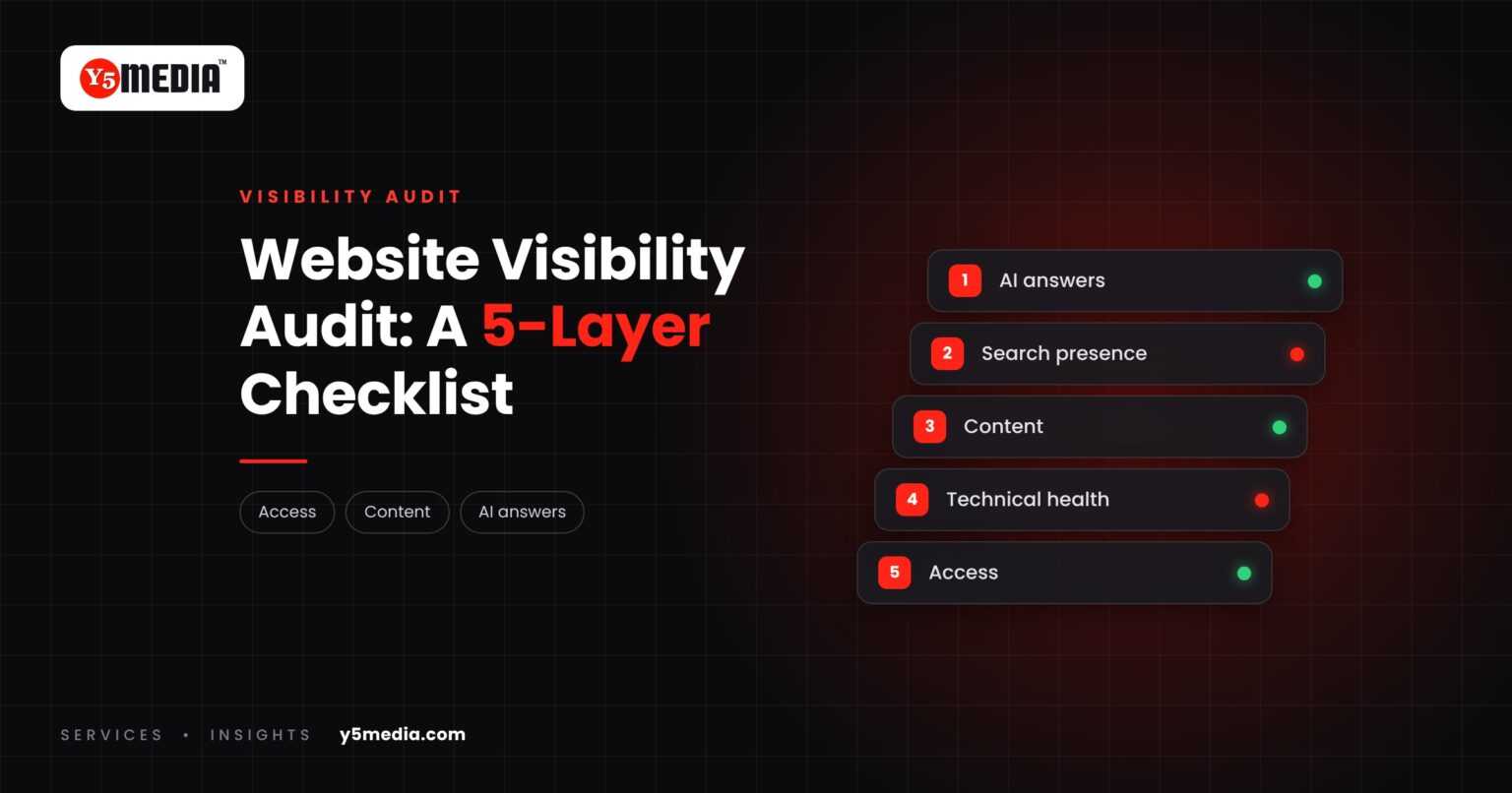
The Five Layers of a Website Visibility Audit
Think of visibility as a stack. Each layer depends on the one below it. There is little point polishing content if search engines cannot crawl the page it sits on.
Layer 1: Access – Can search engines reach your pages?
This is the foundation. If this layer fails, nothing above it matters.
- Indexing status. In Google Search Console, open the Page indexing report. Are your key service pages indexed? If not, what reason does Google give?
- Robots rules. Check that
robots.txtis not blocking important folders, and that no live page carries a leftovernoindextag from development. - XML sitemap. Does it exist, is it submitted, and does it list only pages you actually want found?
- Redirect chains and broken links. Old URLs should point cleanly to their new home in one step, not three.
Layer 2: Technical health – Is the site pleasant and safe to use?
- Mobile experience. Open your site on an ordinary phone on a mobile connection. Can you read, tap and navigate without pinching and zooming?
- Speed. Run key pages through PageSpeed Insights. Look at the field data, which reflects real visitors, not just the lab score.
- Security. HTTPS everywhere, no mixed-content warnings, and plugins or frameworks kept up to date.
- Structured data. Is your organisation, address and service information marked up so machines can read it without guessing?
Layer 3: Content – Does each page clearly answer a real search?
This is where most business websites lose ground. The usual pattern is a single “Services” page listing eight offerings in one paragraph each. Search engines have nothing specific to match against.
- List every service you want enquiries for.
- Next to each, write the phrase a customer would actually search.
- Find the page on your site that answers that phrase. If there isn’t one, note it.
- For pages that do exist, check the headline, the first paragraph and the title tag. Do they say what the page is about in plain words?
- Look for two pages competing for the same phrase. Merge or differentiate them.
Layer 4: Search presence – How do you appear beyond your own site?
Your website is only one of the places customers see you. An audit should look at:
- Google Business Profile – category, services, hours, photos and review responses.
- Business details consistency – name, address and phone number matching across directories, social profiles and your site.
- Search results for your brand – what appears on page one when someone types your name? Is anything outdated, negative or belonging to a different company?
- Backlinks and mentions – are credible sites in your sector referring to you at all?
Layer 5: AI answers – What do AI assistants say about you?
This layer did not exist in audits a few years ago. Now it matters. Ask ChatGPT, Gemini and Google’s AI features the questions your buyers ask. Note whether you are named, whether the details are accurate, and who is recommended instead. This tells you how well the lower four layers are actually working, because AI tools draw on the same signals.
How to Prioritise What You Find
A thorough audit usually produces a long list. The mistake is to work through it top to bottom. Sort findings into four groups instead:
| Group | Example | When to act |
|---|---|---|
| Blockers | Service pages not indexed; site-wide noindex | Immediately |
| Revenue gaps | Key service has no dedicated page | This month |
| Trust gaps | Inconsistent address; unanswered reviews | Next 60 days |
| Polish | Missing alt text; long title tags | Ongoing |
Blockers and revenue gaps are where the return is. Polish items matter, but they rarely change the number of enquiries on their own.
How Often Should You Audit?
Run a full audit when any of these happen:
- Before and after a website redesign or platform change.
- When enquiries drop and you can’t explain why.
- When you launch a new service or enter a new market.
- At least once a year, even when nothing seems wrong.
Between full audits, a monthly glance at Search Console’s indexing and performance reports catches most problems early.
DIY or Specialist?
You can cover Layers 1 and 3 yourself with Search Console and an honest afternoon. Layers 2, 4 and 5 take more time and tools, and the hardest part is interpretation: knowing which findings matter for your business and which are noise.
If you have already worked through the basics in our guide to why businesses don’t show up on Google and still can’t see what’s holding you back, an outside review usually pays for itself in the time it saves.
Frequently Asked Questions
How long does a website visibility audit take?
For a typical small or mid-sized business website, a thorough audit across all five layers usually takes one to two weeks, including time to interpret findings and prioritise fixes. Very large sites or sites with complex histories take longer.
Can I audit my website myself?
Yes, partly. Google Search Console, PageSpeed Insights and an honest review of your service pages will cover access, basic technical health and content. Checking listings consistency, backlinks and AI answers takes more time and tools, and interpreting everything in business terms is where outside experience helps most.
What should I fix first after an audit?
Fix blockers first – anything stopping important pages from being indexed or enquiries from reaching you. Then close revenue gaps, such as a key service with no dedicated page. Cosmetic issues can wait.
What to Remember
- An audit connects technical issues to lost enquiries; a score does not.
- Work bottom-up: access, technical health, content, search presence, AI answers.
- The biggest wins are usually missing pages, not broken tags.
- Sort findings into blockers, revenue gaps, trust gaps and polish.
- Audit before and after every major website change.
How Y5MEDIA Runs a Visibility Audit
Our audits cover all five layers and end with a prioritised order of work, not a PDF of warnings. We look at your site the way Google does, then check how AI assistants describe your business when buyers ask about your category.
From there, our Search Engine Optimization team handles the technical and content fixes, and our AI Visibility Management service tracks how your brand appears in AI answers month by month.
Want an Outside View of Your Website?
Begin with our Free AI Visibility Report to see what AI engines say about you today. For a full five-layer audit with a prioritised fix list, request a proposal.
Sources
- Page indexing report (Google Search Console Help)
- Introduction to structured data markup (Google Search Central)
- PageSpeed Insights (Google)