
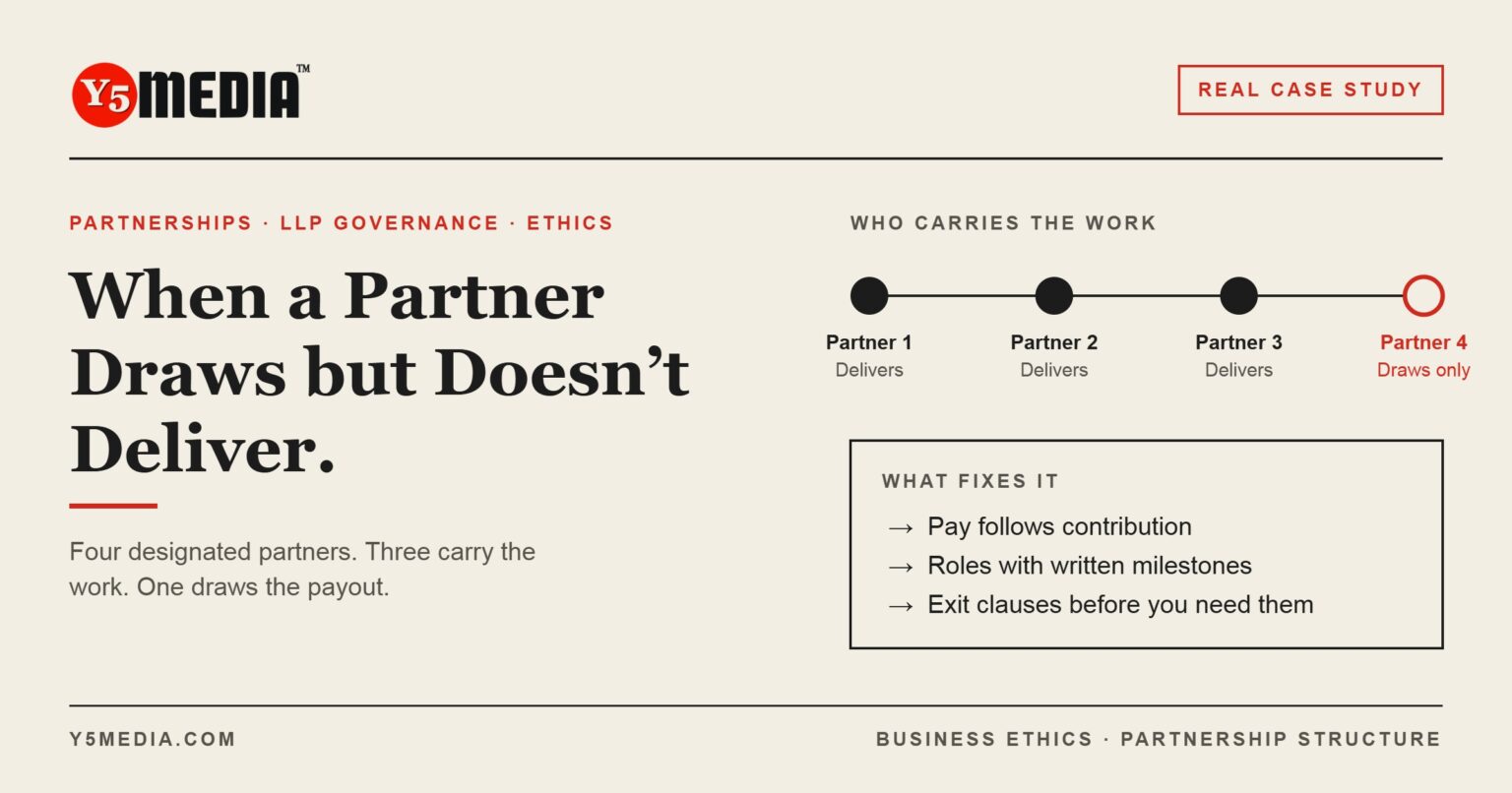
Real case study: a situation from a partner-run technology LLP. Names and identifying details are left out; the problem and the lessons are real.
Industry: B2B software and digital services. Focus: Partnership governance, LLP structure and business ethics
At a glance: In a four-partner LLP, three designated partners carry the work while the fourth draws a monthly payout without delivering the growth he was brought in for. The cause is not one person but a structure that let one person coast. This case study sets out the gaps, the cost and what every LLP should put in writing on day one.
Most partnership breakdowns are not dramatic. There is no fraud and no single bad day. There is a slow, monthly drain that everyone notices and nobody has the paperwork to stop.
The Situation
The firm is a small B2B software and digital services LLP with four designated partners. Three of them run delivery: client projects, technical setup, support and day-to-day operations. They are the reason clients stay.
The fourth partner joined on a verbal understanding that he would lead marketing, build a sales pipeline and bring in new business. In return he would receive a fixed monthly payout as a working partner.
A year on, there is no pipeline to show, no closed deals that trace back to him and no marketing system in place. The monthly payout has continued anyway. He is focused on what he takes out of the firm, not on what he puts in, and he does not yet see that this cannot last.
Why It Went Unchecked
The problem was not one person. It was a structure that let one person coast. Four gaps made it possible:
- Pay was tied to a title, not to output. The LLP Agreement recognised him as a designated partner with remuneration, but attached no measurable targets to that remuneration.
- Payouts ran on autopilot. Monthly drawings went out as a routine accounting entry. Nobody had to ask what each payment had produced.
- The role was never written down. “Handle marketing” was agreed in conversation. There were no milestones, no reporting rhythm and no review date.
- Status became a shield. As a designated partner with a vote, he could slow down decisions, including any decision to hold him to account.
What It Costs
The monthly payout is the visible cost. It is not the largest one.
| Area | What happens |
|---|---|
| Cash | Money that could fund a salesperson, tools or runway leaves every month with nothing coming back. |
| Team morale | The people doing the work watch effort go unrewarded while a title gets paid. Good people stop going the extra mile. |
| Decisions | Every change needs a vote, and one partner with nothing to lose can stall all of them. |
| Growth | The role that was meant to bring in business is occupied, so nobody else is hired to do it. |
The hardest part is that the working partners subsidise the arrangement. The non-performing partner bears none of its cost until the structure changes.
How the Working Partners Are Responding
Waiting for him to realise the problem was the tempting option. It was also the expensive one, because every month of waiting is paid for by the three partners doing the work. They chose a calm, documented approach instead of an argument.
- Secure operations first. Client platforms, hosting, domains and admin credentials sit with the partners who run delivery. This is ordinary operational hygiene, and it keeps clients safe whatever happens next. Statutory rights, such as access to the LLP’s books, are left untouched.
- Tie payouts to contribution, for everyone. A proposal that all partner remuneration be backed by a simple monthly contribution report: work delivered, leads generated, deals closed. The same rule applies to all four, so it cannot be called a personal attack.
- Build a factual record. What was agreed, what was asked, what was delivered, with dates. Kept in writing, kept unemotional.
- Offer a clean exit. Once pay follows performance, the choice becomes simple: contribute, or step back through a negotiated separation. Drawings already taken are a fair part of that conversation.
Every step is checked against the LLP Agreement and the LLP Act before it is taken. In most agreements, expelling a partner or changing remuneration terms needs a specific clause or the consent the agreement sets out, so the order of steps matters.
What Every LLP Should Put in Writing on Day One
- Pay follows contribution. Attach measurable targets to every partner’s remuneration in the agreement or a signed annexure. A title alone earns nothing.
- Roles have milestones. Write down what each partner owns, what success looks like at 3, 6 and 12 months, and when it will be reviewed.
- Exit and removal clauses exist before you need them. Spell out how a partner can be asked to leave, how their stake is valued and what voting threshold applies.
- Operations stay with operators. The partners who run client work hold the systems, credentials and access that client work depends on.
- Review regularly, not only in a crisis. A quarterly partner review makes underperformance visible in months, not years.
Partnerships rarely fail because someone is lazy. They fail because the agreement allowed it.
A Closing Note
The partner who takes without building usually believes the arrangement will continue. It rarely does. By the time he notices the structure has changed, the leverage he relied on is gone.
For the rest of us, the lesson is simpler: integrity is easier to keep when it is built into the agreement, not left to good intentions.
This case study is shared for general learning and is not legal advice. Partnership disputes depend on the specific LLP Agreement; speak to a chartered accountant or corporate lawyer before acting.