
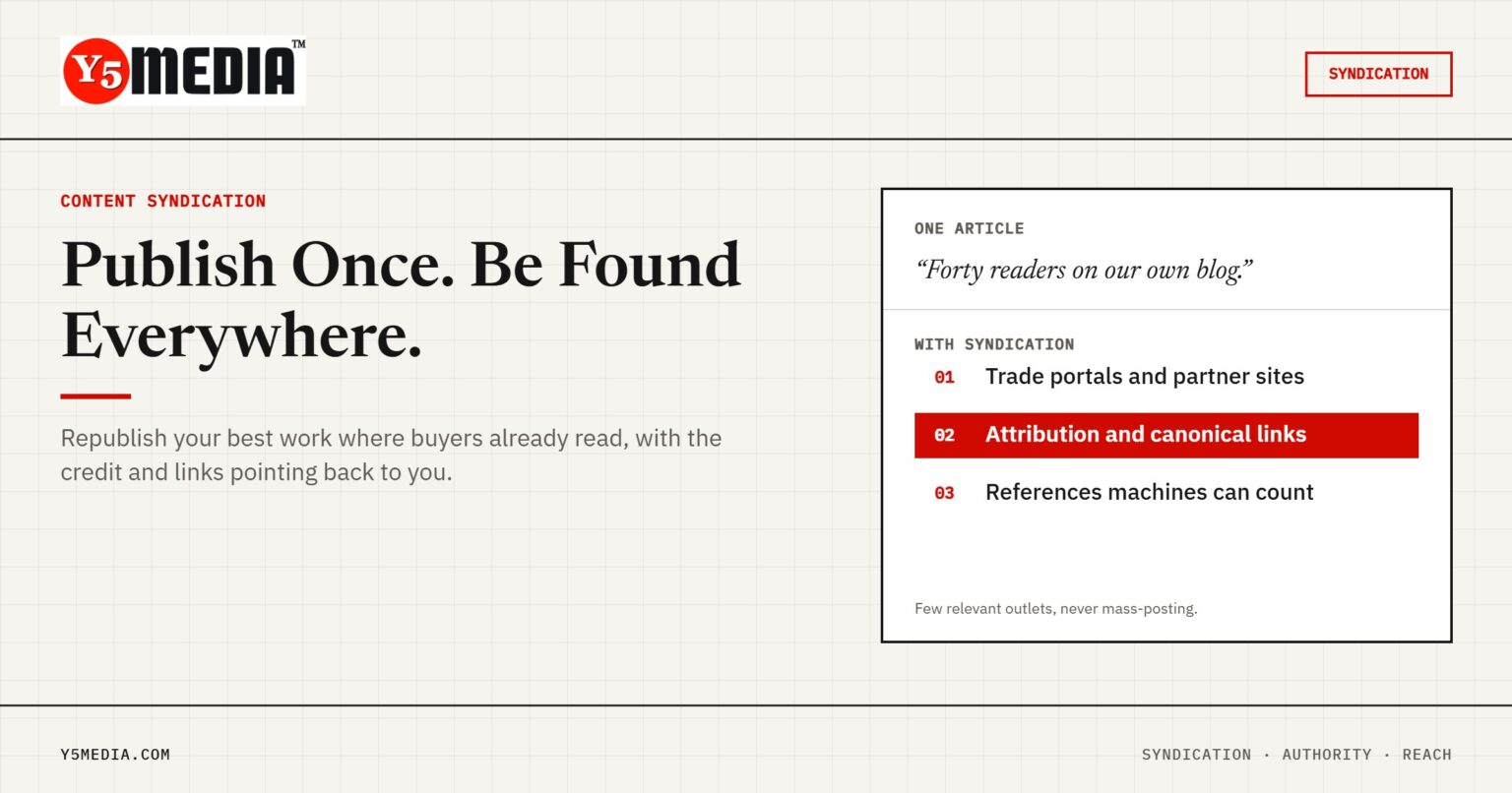
A good article read by forty people on your own blog is a missed opportunity. Content syndication republishes your best pieces on partner sites, industry portals and platforms where your buyers already read, with the credit and the links pointing back to you. Done properly it multiplies reach, earns references that search engines and AI assistants count, and costs far less than writing something new for every channel.
This article covers how syndication works, how to avoid the duplicate-content worry, and how Y5MEDIA runs it for B2B clients in India and the Gulf.
What syndication does for you
- Reach beyond your own traffic. Your article appears where readers already are: trade portals, industry newsletters, partner blogs, professional platforms.
- Third-party references. Each placement is another credible source describing your business, which feeds both search authority and AI recommendations.
- Longer life for good work. A strong piece gets a second and third audience instead of fading after a week.
- Relationships with editors. Regular, useful contributions make you a known name when a journalist needs a comment.
The duplicate-content question, answered
Search engines do not penalise syndication; they decide which copy to show. The risk is that the syndicated copy outranks yours. We handle that with canonical tags pointing to your original where the outlet allows it, a delay before republishing so your version is indexed first, and clear attribution with a link back in every case. Where an outlet will not allow a canonical, we syndicate an excerpt or an adapted version instead.
How Y5MEDIA runs syndication
- Select the pieces. Not everything travels. We choose articles with a clear angle that an outside audience would value.
- Map the outlets. Trade portals, industry sites, partner blogs and professional platforms matched to your sector and markets.
- Adapt where needed. A new headline, a sharper introduction, a version for a different market.
- Place with attribution. Author credit, company description and links agreed in writing with the outlet.
- Track. Where each piece appeared, what it linked to, and the traffic and enquiries it produced.
What we will not do
We will not pay for placement and call it editorial, syndicate to sites nobody reads, or republish without attribution. Syndication only works when every placement would survive a buyer looking at it closely.
Frequently Asked Questions
Will syndication hurt our rankings?
Not when done properly: canonical tags where possible, a delay so your original indexes first, and clear attribution. We avoid the mass-posting that causes problems.
Which outlets do you use?
It depends on your sector and markets. We map trade portals, industry sites and partner platforms that your buyers actually read, in India, the Gulf or both.
Can we syndicate old content?
Often, yes. Strong older pieces can be updated and given a new audience.
Is this the same as a press release?
No. Press releases announce news through distribution channels. Syndication republishes substantive articles with your byline.
How is it measured?
Placements, referral traffic, links earned, and enquiries traced to syndicated pieces, reported monthly.
Give Your Best Work a Second and Third Audience
Send us your three strongest articles and we will tell you where they could be republished and on what terms. Email support@y5media.com or message us on WhatsApp.