
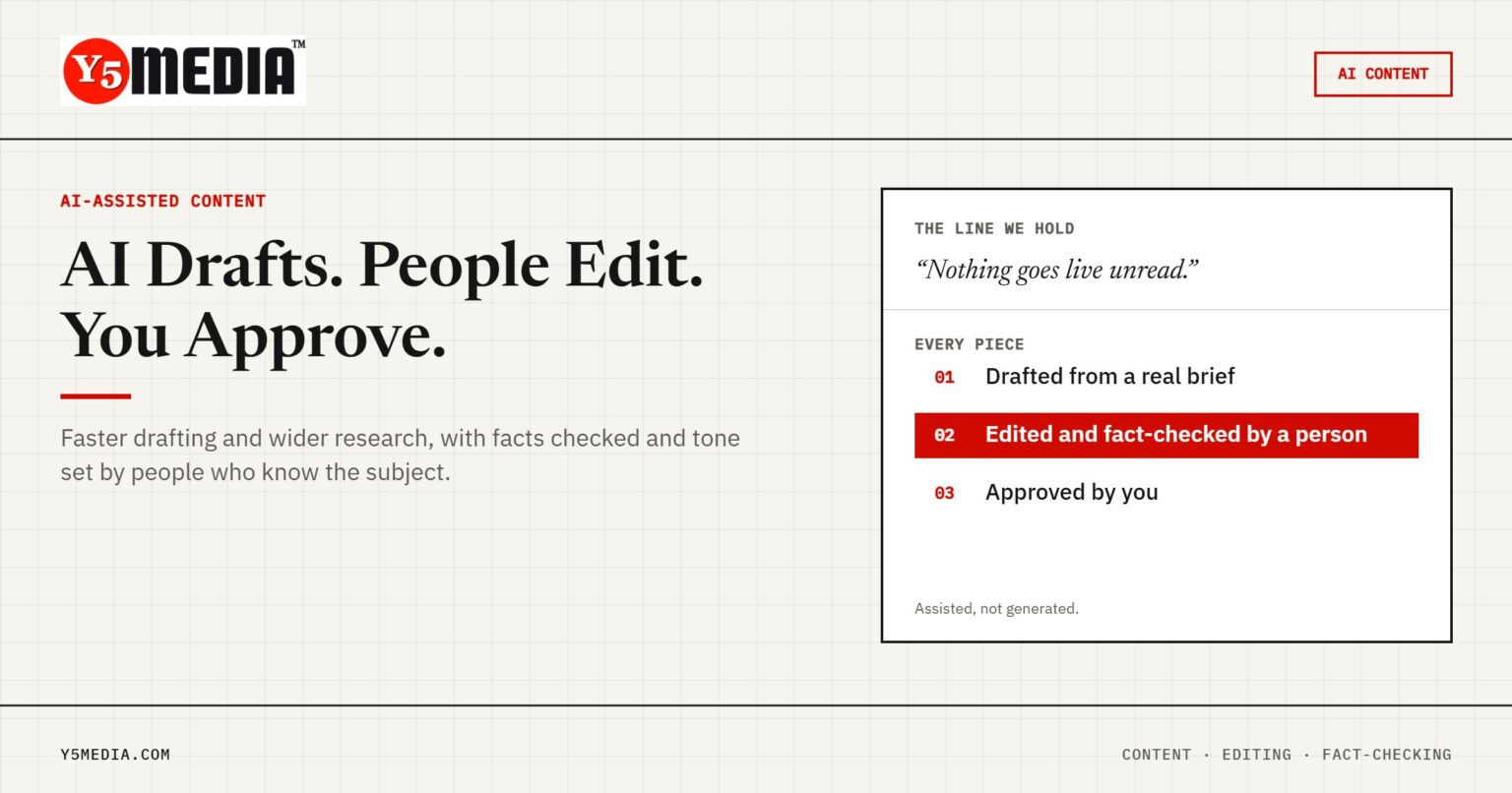
AI can draft an article in seconds. It cannot know what your clients actually ask, what you have actually done, or what you would never say. The businesses getting value from AI in content are not the ones publishing the most; they are the ones using it to draft faster, research wider and keep a schedule, while people decide what is true, what matters and how it sounds.
This article explains how Y5MEDIA uses AI in content work, where we draw the lines, and why “AI-assisted” and “AI-generated” are not the same thing.
Where AI genuinely helps
- First drafts. A structured starting point from a brief, so writers spend their time improving rather than staring at a blank page.
- Research breadth. Surfacing the questions people ask, the angles competitors cover, the terms a sector uses.
- Consistency and cadence. Keeping a monthly calendar on schedule without burning out a small team.
- Repurposing. Turning one substantial article into social posts, a newsletter section and a FAQ, with a person checking each.
- Local-language drafts. A starting point for content in the languages your customers use, reviewed by a native speaker before publication.
Where it must not be left alone
- Facts. Models invent statistics, dates and quotes with complete confidence. Every figure is checked against a source or removed.
- Claims about you. AI does not know your clients, results or limits. Anything about your business is written from what you have actually told us.
- Tone. Unedited AI text has a recognisable flatness. Editors give it a point of view and cut the padding.
- Sensitive sectors. Healthcare, legal, finance and education content needs expert review, not just editorial review.
- Disclosure. Where a platform or client requires disclosure of AI assistance, we provide it.
The process at Y5MEDIA
- Brief. The question the piece answers, the audience, the facts we have, the sources we may use, and what must not be said.
- Draft. AI-assisted, from the brief, into our structure.
- Edit. A writer rewrites for accuracy, voice and usefulness; weak sections are replaced, not polished.
- Fact-check. Every claim traced to a source or cut.
- Approval. Your reviewer signs off. Then it is published, structured and distributed.
Why this matters for search and AI visibility
Search engines are getting better at identifying low-effort generated text and discounting it. AI assistants cite sources that say something specific and verifiable. Content that is merely fluent is not enough; content that is accurate, particular to your business and edited by someone who understands the subject is what gets found and quoted.
Frequently Asked Questions
Do you publish AI-generated content?
We publish AI-assisted content: drafted with AI, edited and fact-checked by people, approved by you. Unedited AI text is not published.
Will search engines penalise AI content?
They discount low-quality content regardless of how it was made. Well-edited, accurate, specific content performs; thin generated text does not.
How do you handle facts?
Every statistic, date and claim is traced to a source we can show you, or it is removed.
Can you write in our tone?
Yes. We build a short style guide from your existing material and editors apply it; AI drafts are a starting point, not the voice.
Is it cheaper than fully human writing?
It is usually faster, which lowers cost per piece. The saving is in drafting and research, not in editing or checking, which stay human.
Faster Drafts, Human Judgement, Your Approval
Ask us for a sample: one article from your brief, with the draft, the edit and the fact-check notes shown side by side. Email support@y5media.com or message us on WhatsApp.