
When a potential customer hears your business name, from a friend, a supplier or a search result, what do they find when they look you up?
For many businesses, the honest answer is a patchwork: a website from a few years ago, a Facebook page with one post, a Google listing someone else created, and a LinkedIn profile that still shows an old job title. None of it is wrong exactly. But together it doesn’t inspire confidence.
A strong digital presence isn’t about being everywhere. It’s about being findable, consistent and credible in the places your customers actually look.
What “Digital Presence” Really Means
Your digital presence is everything a person or a machine can learn about your business online. That includes what you publish yourself, what platforms show about you, and what others say about you.
Customers use it to answer three questions quickly:
- Is this business real and active?
- Does it do what I need?
- Can I trust it?
Every element of your presence should help answer those questions.
The Five-Layer Framework
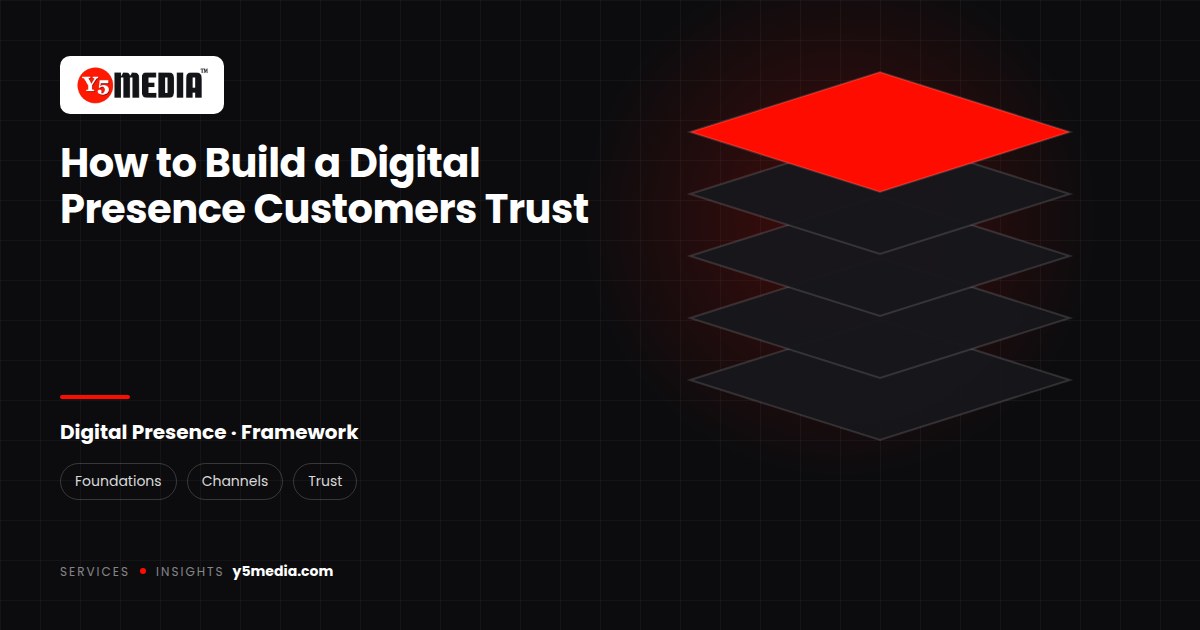
It helps to think of digital presence as five layers, built from the ground up. Skipping lower layers to focus on the exciting ones, such as social media campaigns, usually wastes effort.
Layer 1: Foundations
- A registered domain you control, with business email on that domain rather than a free email address
- A secure, fast, mobile-friendly website
- Consistent business name, address, phone number and logo
- Access to all your accounts held by the business, not only by a former employee or agency
Layer 2: Discoverability
- A verified Google Business Profile, if you serve customers in a location
- Search-friendly service pages
- Listings on the directories and platforms that matter in your industry
- Search engines able to crawl and index your website
Layer 3: Voice
- A clear, repeated description of what you do and whom you serve
- Social media profiles on the one or two platforms your customers use, kept active
- Regular, useful content: articles, short videos, updates
Layer 4: Proof
- Reviews on Google and relevant industry platforms
- Real project examples and case studies
- Credentials, registrations and memberships that customers can verify
- Mentions in media, industry publications or partner websites
Layer 5: Conversation
- Easy ways to start a conversation: WhatsApp, chat, phone, email
- Prompt responses
- Follow-up processes so enquiries don’t fall through gaps
Consistency Is the Hidden Multiplier
Inconsistency is one of the most common, and most overlooked, problems. Examples include:
- A different business name spelling on your website and Google profile
- Three phone numbers across different platforms
- An old logo on LinkedIn and a new one on the website
- Different descriptions of what the business does on every platform
People notice these differences, even subconsciously. Search engines and AI systems notice too, because consistent information makes it easier to connect all your profiles to one business entity. That’s the idea behind entity-based optimization.
A Practical 90-Day Plan
Days 1–30: Get the foundations right
- Audit every existing profile and listing. Note who controls each one.
- Standardise your business name, description, phone, address and logo.
- Fix critical website issues: mobile layout, speed, contact options, security.
- Claim and complete your Google Business Profile.
Days 31–60: Become discoverable and clear
- Create or improve one page for each core service.
- Choose one or two social platforms and complete those profiles fully.
- Publish your first useful content pieces, answering real customer questions.
- Start asking satisfied customers for reviews.
Days 61–90: Build proof and momentum
- Publish at least one detailed project example or case study.
- Look for opportunities to be mentioned by partners, associations or local media.
- Set a realistic posting and content rhythm you can maintain.
- Review what’s working and adjust.
Choosing the Right Channels
Not every business needs to be on every platform. A few examples:
| Business type | Channels that often matter most |
|---|---|
| Local clinic or salon | Google Business Profile, WhatsApp, Instagram |
| B2B service firm | Website, LinkedIn, industry publications |
| School or college | Website, Google profile, Facebook, YouTube |
| Retail brand | Instagram, marketplaces, Google Shopping, WhatsApp |
| Technology company | Website, LinkedIn, technical content, review platforms |
The best channel is the one your customers already use and you can maintain consistently.
Common Digital Presence Mistakes
- Opening accounts on every platform, then abandoning most of them. An inactive profile can suggest the business itself is inactive. It’s better to close or hide channels you can’t maintain.
- Letting one person own all the logins. When that employee or freelancer leaves, the business can lose access to its own website, domain or social accounts.
- Using a free email address for business. A business email on your own domain looks more credible and stays with the company.
- Posting only promotions. Audiences follow accounts that inform, help or entertain, not accounts that only sell.
- Ignoring messages and comments. A digital presence is two-way. Unanswered questions in public are visible to everyone.
- Chasing trends that don’t fit. Not every business needs to be on the newest platform.
How to Tell Whether It’s Working
Digital presence is broad, so measure a few meaningful indicators rather than everything:
| What to track | Why it matters |
|---|---|
| Searches for your business name | Shows growing awareness and recall |
| Google Business Profile views, calls and direction requests | Shows local discoverability |
| Website enquiries by source | Shows which channels bring real interest |
| Review count and average rating | Shows reputation growth |
| What AI assistants say about you | Shows whether your information is understood accurately |
| Enquiries mentioning “I saw you online” | A simple, honest signal worth asking about |
Review these every month or quarter. The trend matters more than any single number.
What to Remember
- Digital presence is everything customers and machines can learn about you online.
- Build in layers: foundations, discoverability, voice, proof, conversation.
- Consistency across platforms is essential for trust and for search engines.
- Focus on the few channels your customers use, and keep them active.
- A 90-day plan turns an overwhelming task into manageable steps.
What You Can Do Next
- List every profile and listing, and who controls each one.
- Standardise your business name, description, phone number and logo.
- Choose the one or two social channels your customers actually use.
- Work through the 90-day plan, one layer at a time.
- Review the measures in this article every month.
How Y5MEDIA Can Help
Y5MEDIA helps businesses build their digital presence layer by layer. We start by auditing what already exists, then fix foundations through WordPress Development and Search Engine Optimization, and strengthen consistency with Entity-Based Optimization.
For voice and proof, our Social Posting & Engagement and Content Publication services keep your channels active, while WhatsApp Integration & Automations help turn interest into conversations.
Entity-Based Optimization
Consistent business data so search engines and AI connect every profile to you.
Learn more →Social Posting & Engagement
Keep your chosen channels active with regular, useful posts and replies.
Learn more →WhatsApp Integration & Automations
Turn interest into conversations and make review requests effortless.
Learn more →Build a Presence Customers Can Trust
Whether you’re starting fresh or tidying up years of scattered profiles, Y5MEDIA can help you plan and execute. Request a proposal, contact our team, or explore our services at y5media.com.