
“We should start a blog.” It’s a sentence spoken in countless marketing meetings. A few articles get written, published, shared once on LinkedIn, and then the blog quietly stops.
The problem is rarely effort. It’s that the content wasn’t connected to how customers make decisions. Content that turns visitors into customers is planned around the questions buyers ask at each stage, and it always gives them a clear next step.
Why Most Business Content Doesn’t Convert
Common patterns behind content that attracts few leads:
- Written about the company, not the customer. Announcements and awards interest you more than your prospects.
- Too generic. “10 Marketing Tips” articles compete with thousands of similar pieces.
- No next step. Readers finish an article and leave, because nothing invites them further.
- Inconsistent. Three articles one month, none for the next six.
- Disconnected from sales. Sales teams answer the same questions every week, but content never addresses them.
Map Content to the Buying Journey
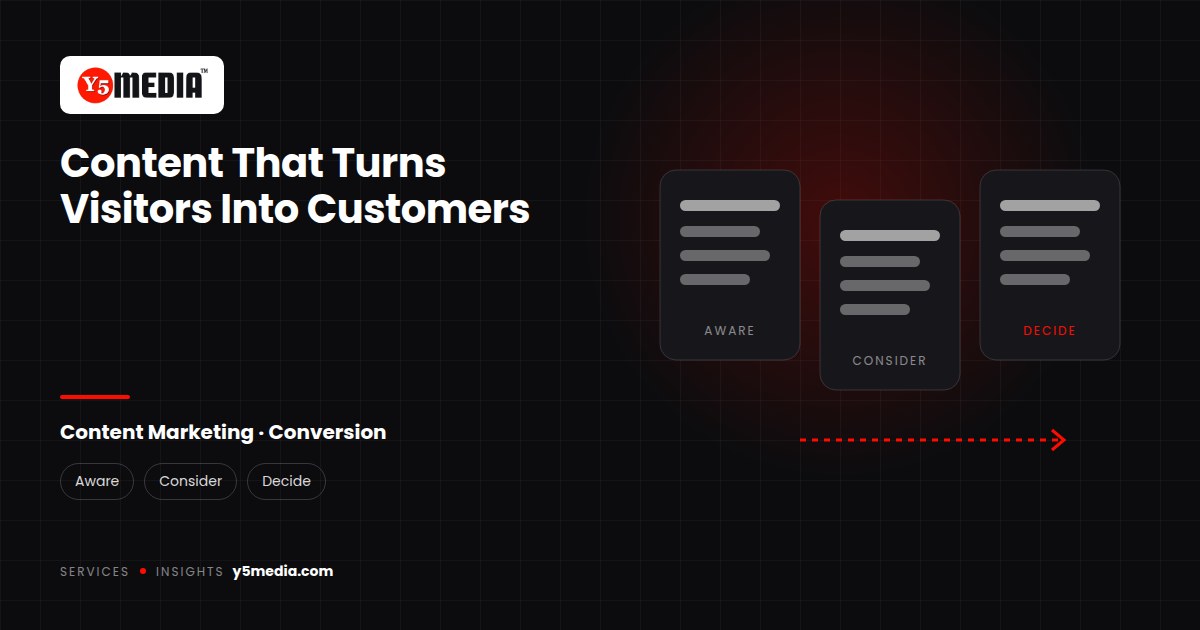
Customers move through stages before choosing a provider. Each stage needs a different kind of content.
| Stage | What the buyer is thinking | Useful content | Next step to offer |
|---|---|---|---|
| Awareness | “I have a problem. What is it?” | Explainers, guides, problem diagnosis | Related article, newsletter or checklist |
| Consideration | “What are my options?” | Comparisons, how-to-choose guides, pros and cons | Case study, consultation |
| Decision | “Who should I trust with this?” | Case studies, process explanations, pricing approach, FAQs | Contact, proposal, demo |
| Retention | “Am I getting the most from this?” | Tips, updates, training resources | Upgrade, referral, review |
Most businesses over-produce awareness content and under-produce decision content. Yet decision content is often what tips a prospect into contacting you.
Start With Questions You Already Hear
The best content ideas are usually sitting in your inbox. Ask your sales and support teams:
- What do prospects ask before buying?
- What misconceptions do we correct repeatedly?
- Why do people choose us, and why do they choose competitors?
- What do customers struggle with after buying?
Each answer can become an article, a short video, a FAQ entry or a social post. Content based on real questions tends to be specific, genuinely useful and far less generic.
Make Every Piece Work Harder
Give readers a relevant next step
Match the call to action to the stage. Someone reading “What is an ERP?” isn’t ready for a sales call, but might want a related guide. Someone reading “How to migrate from your old ERP” may well want to talk to you.
Show your experience
Specific examples, lessons learned and honest limitations separate expert content from generic writing. Google’s guidance on helpful content emphasises experience and expertise, and readers notice it too.
Structure for skimming
Use clear headings, short paragraphs, lists and tables. Many readers scan before deciding to read.
Repurpose, Don’t Just Publish
One solid article can feed many channels:
- A LinkedIn post summarising three key points
- A short video explaining the main idea
- An infographic or carousel
- A section of your newsletter
- Answers for your FAQ page
- Talking points for your sales team
- A syndicated or published version on relevant industry platforms
Repurposing multiplies reach without multiplying research effort.
Consistency Beats Volume
Two genuinely useful pieces a month, published reliably for a year, usually do more than twenty rushed articles in one burst. Choose a rhythm your team can sustain, and protect it.
Track what matters: which pieces bring organic visitors, which lead readers to service pages, and which are mentioned by prospects in sales conversations.
A Simple Content Plan You Can Start With
For a small team, a sustainable monthly plan might look like this:
| Each month | Purpose |
|---|---|
| One in-depth article answering a common buyer question | Search visibility and trust |
| One case study, project story or process explanation | Decision-stage proof |
| Four to eight social posts drawn from those two pieces | Reach and reminders |
| One short video or visual summary | Engagement on mobile and social platforms |
| A short email or WhatsApp update to past customers | Retention and referrals |
That’s manageable for most businesses, and over a year it builds a substantial library of useful material.
Formats Beyond the Blog
Written articles are valuable for search, but people consume content in many ways:
- Short videos explaining a concept or showing a process
- Customer stories told in the customer’s own words, with permission
- Checklists and templates readers can download and use
- Webinars or live Q&A sessions for complex topics
- Podcasts or audio clips for audiences who listen while commuting
- Local language versions of key content, where your customers prefer it
Choose formats your customers actually use and your team can produce well.
Using AI in Content, Responsibly
AI writing tools can speed up research, outlines, first drafts and repurposing. Used carelessly, they produce generic content that looks like everyone else’s and may contain mistakes.
A sensible approach: use AI to accelerate the work, but make sure every published piece includes your real experience, is checked for accuracy by someone who knows the subject, and genuinely helps the reader. Google’s guidance focuses on whether content is helpful and reliable, not simply on how it was produced.
What to Remember
- Content converts when it answers real buyer questions at each stage of the journey.
- Many businesses lack decision-stage content such as case studies and process explanations.
- Mine your sales and support conversations for content ideas.
- Always give readers a relevant next step.
- Repurpose each piece across channels and publish consistently.
What You Can Do Next
- Ask your sales and support teams for the ten most common customer questions.
- Map each question to a stage of the buying journey.
- Publish one decision-stage piece first, such as a case study.
- Add a relevant next step to every existing article.
- Commit to a monthly content rhythm you can sustain.
How Y5MEDIA Can Help
Y5MEDIA plans and produces content around your customers’ buying journey. Our Content Publication and Content Syndication services cover articles, corporate video, reels, podcasts and photography, in English and local language where needed.
We distribute that content through Distribution & Syndication and Social Posting & Engagement, and use AI Content Generation responsibly to help produce and repurpose content faster, always with human review.
Content Publication
Articles, corporate video, reels, podcasts and photography, in English and local language.
Learn more →Distribution & Syndication
Share every content piece across the channels your audience uses.
Learn more →Social Posting & Engagement
Keep your chosen channels active with regular, useful posts and replies.
Learn more →Build Content That Brings Customers
If your content isn’t producing enquiries, let’s plan something better. Get a proposal, contact our team, or explore our services at y5media.com.
Sources
- Creating helpful, reliable, people-first content (Google Search Central)