
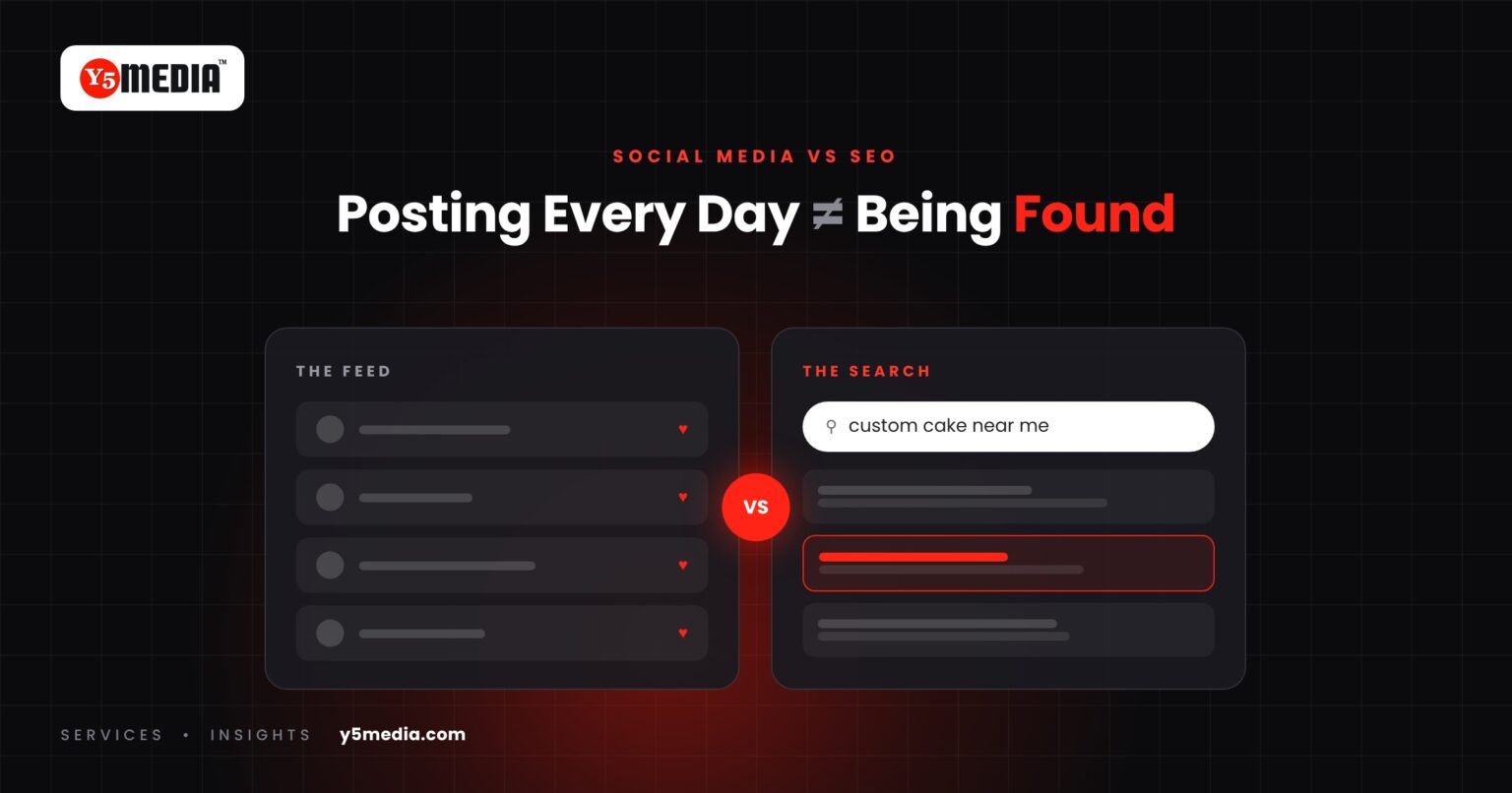
A bakery posts beautiful photos every morning. The account has thousands of followers and the comments are warm. Yet when someone new to the area searches “custom birthday cake near me”, the bakery doesn’t appear anywhere.
That gap is more common than most owners realise. Social media activity and digital visibility are related, but they are not the same thing. One keeps you in front of people who already know you. The other puts you in front of people who are actively looking for what you sell and haven’t heard of you yet.
Two Different Kinds of Attention
The easiest way to see the difference is to look at the moment each channel reaches someone.
| Social media | Search and AI answers | |
|---|---|---|
| When they see you | While scrolling, not looking for anything | While actively looking for a solution |
| Who they are | Mostly existing followers and their networks | Anyone with the need, including strangers |
| How long it lasts | A post is mostly seen within a day or two | A good page can bring visitors for years |
| Who controls reach | The platform’s feed algorithm | Your site’s relevance, quality and trust |
| Best at | Loyalty, personality, repeat purchase | Discovery, comparison, first enquiry |
Neither column is better. They do different jobs. The problem starts when a business expects its social feed to do the job of the second column.
The Rented-Land Problem
Your social profiles sit on someone else’s platform. That has three practical consequences:
- Reach can change overnight. A change to the feed algorithm can cut how many followers see your posts, and you have no say in it.
- Accounts can be restricted or lost. Hacked accounts, mistaken policy flags or a departing employee who held the login can take years of work with them.
- Content is hard to find later. A detailed post you wrote about your process eight months ago is effectively invisible to someone searching for it today.
None of this is a reason to stop posting. It is a reason not to let social media be the only place your business exists online.
Five Signs You’re Relying Too Heavily on Social
- Most new enquiries come from people who already follow you or were referred by someone who does.
- Your website hasn’t been meaningfully updated since launch, while your social accounts are updated daily.
- Searching your main service plus your city doesn’t bring up your website or business profile on the first page.
- Your best explanations live only in captions – pricing guidance, process, FAQs – and nowhere on your site.
- You can’t tell which enquiries came from where, so you keep investing in the channel that feels busiest.
If three or more sound familiar, your visibility is narrower than your follower count suggests.
What an Integrated Presence Looks Like
An integrated presence means each channel feeds the others instead of running in parallel.
Your website is the hub
Every service has a page that answers the questions a buyer asks before getting in touch. This is what search engines and AI assistants read when deciding whether to show or mention you.
Social media is the amplifier
Posts point back to those pages. A reel showing a finished project links to the project page. A carousel on “five questions to ask before hiring” links to the full guide on your site.
Search listings are the front door
Your Google Business Profile, directory listings and social profiles all carry the same name, address, phone and description, so search engines can confidently connect them to one business.
Content moves in both directions
Questions customers ask in comments and messages become website FAQs. Website articles become short social posts. Nothing useful is written only once.
How to Rebalance Without Starting Over
You don’t need to post less. You need to redirect some of that effort.
- Audit your best-performing posts. The topics that get saves and questions are the topics customers care about. Turn the top five into proper website pages.
- Fix your profile links. Point bio links to specific service pages or a simple enquiry page, not just the homepage.
- Make business details consistent across every platform and your website.
- Add basic tracking. Tagged links in your posts show which ones actually send people to your site and which enquiries follow.
- Set a ratio. For every few social posts, publish or improve one piece of website content. The website grows steadily instead of standing still.
Where Paid Social Fits
Paid social ads can reach people outside your follower base, and for launches or seasonal offers they work well. But reach stops when spending stops. Organic search and a well-built website are what keep bringing enquiries after a campaign ends. Used together, ads create short bursts of demand while search captures the steady, ongoing demand that already exists.
For a broader look at how the pieces of an online presence build trust, see our guide on building a digital presence customers can trust.
Frequently Asked Questions
Does social media activity help SEO?
Not directly in the way most people assume. Likes and followers aren't a ranking factor for your website. But social activity can bring visitors to your pages, help content get noticed and linked to, and reinforce consistent business information across the web – all of which support visibility indirectly.
Should a small business focus on social media or SEO first?
If people already search for what you sell, start by making sure your website and business profile can be found for those searches, because that demand exists whether you post or not. Keep social media running alongside it to stay in front of existing customers.
Can a social media page replace a website?
It can work as a stopgap, but it leaves you dependent on one platform's rules and reach, and it gives search engines and AI assistants far less to work with. A simple, well-structured website is a far more durable foundation.
What to Remember
- Social reaches people who know you; search reaches people who need you.
- Social platforms are rented land – your website is the asset you own.
- Your best social content should also live on your website.
- Consistent business details connect your channels in search engines’ eyes.
- Keep posting, but point that effort back to pages that can be found.
Connecting Social and Search With Y5MEDIA
We work with businesses whose social accounts are active but whose search presence hasn’t kept up. Our Social Posting & Engagement team plans content that links back to your site, while our Search Engine Optimization work makes sure those pages can actually be found.
Busy on Social but Hard to Find on Search?
We’ll review your social profiles, website and search listings together and show you where the gaps are between them. Get in touch or request a proposal to start.