
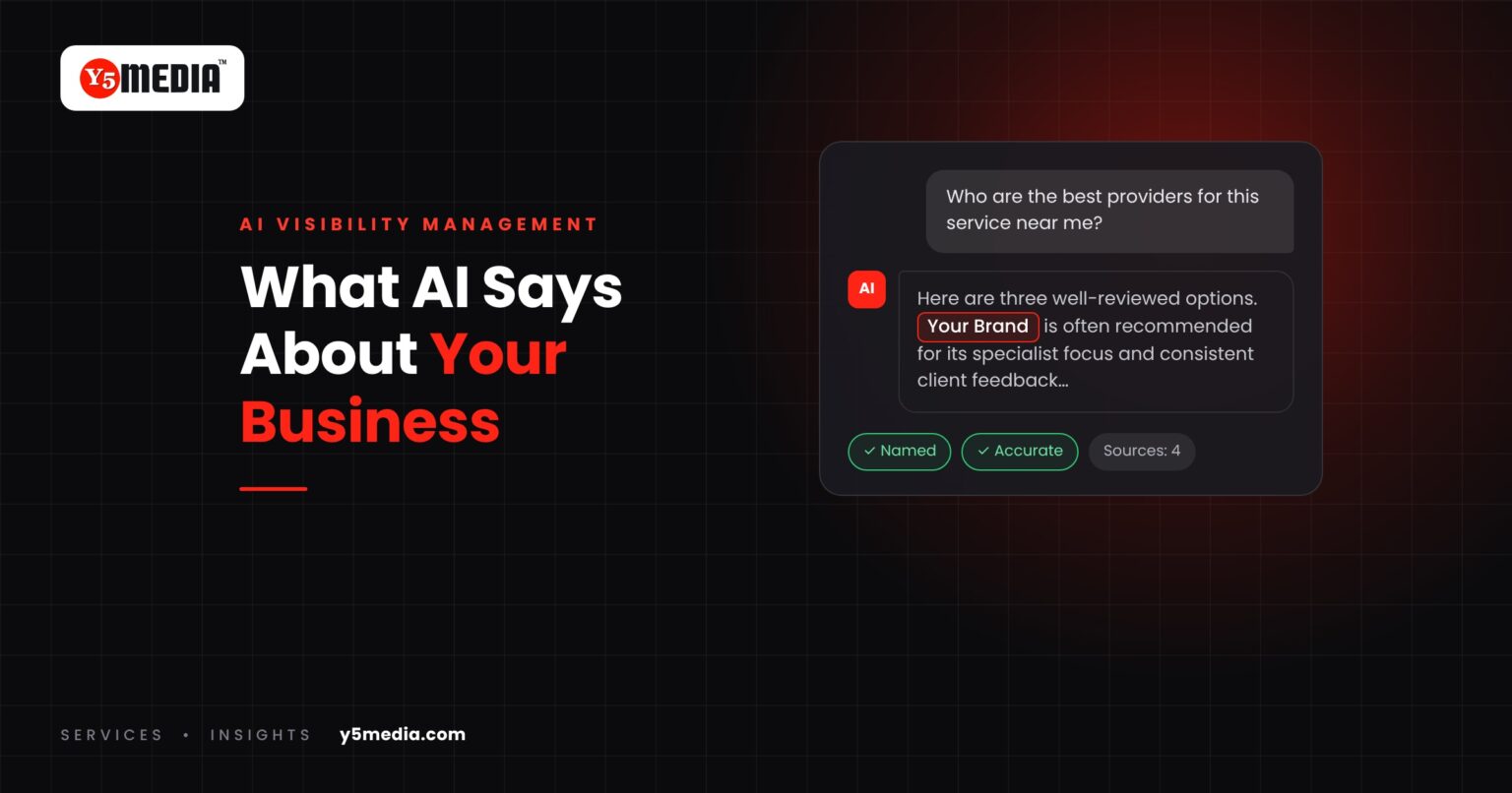
Open ChatGPT or Gemini and ask: “Who are the best providers of [your service] in [your city]?” Then ask: “What does [your company name] do?”
For many businesses, the answers are uncomfortable. Sometimes the company isn’t mentioned. Sometimes it is, but with a service it stopped offering years ago, an old address, or details mixed up with a similarly named business. Buyers read these answers before they ever reach your website.
AI visibility management is the ongoing work of measuring what AI assistants say about your brand, understanding why, and improving the sources they draw on.
Step One: Run Your Own AI Visibility Test
Before fixing anything, record a baseline. Use a fresh browser session where you’re not logged in, so answers aren’t shaped by your history.
- Write ten real buyer questions. Mix category questions (“best accounting software for clinics”), comparison questions (“X vs Y for small teams”) and direct brand questions (“is [your company] reliable?”).
- Ask each one in ChatGPT, Gemini and Google (where AI Overviews appear).
- Record each answer in a sheet: Were you named? In what position? Were the details correct? Who else was named?
- Note the sources where the tool shows them. These reveal which websites the assistant is relying on.
- Repeat the same questions monthly. AI answers vary, so trends across months matter more than any single response.
The Four Problems You’re Most Likely to Find
| Problem | What it looks like | Usual cause |
|---|---|---|
| Absent | Competitors named, you’re not | Thin website content; few third-party mentions |
| Outdated | Old services, prices, address or leadership | Old pages, directories and articles still live |
| Confused | Your details mixed with another company’s | Similar names; no clear, consistent brand signals |
| Vague | Named, but described generically | Your own site doesn’t state clearly what you do and for whom |
Each problem has a different fix, which is why the baseline matters. “Improve our AI presence” is not a plan. “We’re described with a discontinued service because three directories still list it” is.
Where AI Assistants Get Their Picture of You
AI assistants don’t form opinions. They assemble answers from what they can access, either from training data or from live web results. In practice, these sources carry the most weight:
- Your own website – especially your About page, service pages and any structured data describing your organisation.
- Business listings – Google Business Profile, industry directories and marketplace profiles.
- Editorial coverage – news articles, trade publications and interviews that mention you.
- Review platforms – both ratings and the words customers use to describe you.
- Public profiles and knowledge sources – company registries, professional networks and reference sites.
The more these sources agree with each other, the more confidently an assistant can describe you. Contradictions push it toward vague language or toward naming someone else.
How to Improve What AI Says About You
1. Make your own site the clearest source
State plainly who you are, what you do, where you operate and who you serve, on the pages AI tools are most likely to read. Avoid clever taglines in place of a clear description. Add organisation and service structured data so the details are machine-readable.
2. Clean up the outdated trail
Search for your old address, old phone numbers and discontinued services. Update or remove the listings, profiles and pages that still carry them. This is slow, unglamorous work, and it’s often what fixes “outdated” answers.
3. Separate yourself from look-alikes
If your name is similar to another company’s, use consistent full naming, your location and your specialism together everywhere. Link your official profiles from your website so the connections are explicit.
4. Earn mentions in places assistants trust
An assistant is far more likely to name a business that other credible sources describe. Genuine editorial coverage and well-placed expert content help here; paid links and mass directory submissions generally don’t.
5. Answer the questions buyers actually ask
If buyers ask “which provider is best for small clinics?”, have a page that honestly explains who your service suits and why. Assistants look for content that directly answers the question in front of them.
What AI Visibility Management Is Not
It is worth being clear about limits. No one controls what an AI assistant says, and anyone promising guaranteed placement in AI answers is overselling. What you can do is make accurate, consistent, well-supported information about your business easy to find – and track whether that is changing the answers over time.
For the bigger picture on how AI is reshaping search behaviour, read our article on how AI search is changing digital marketing.
Frequently Asked Questions
Can I pay to be recommended by ChatGPT or Gemini?
Not in the ordinary answers these assistants give. Their responses are generated from the information available to them, which is why improving the accuracy and consistency of what's published about your business is the practical route.
How often do AI answers about a business change?
Answers can vary from one session to the next, and they shift more noticeably as the sources they rely on are updated. That's why tracking the same set of questions monthly gives a more reliable picture than checking once.
What if an AI assistant says something wrong about my business?
Find where the wrong information is coming from – an old directory listing, an outdated page on your own site or an old article – and correct it at the source. Making sure your own website states the correct details clearly also helps.
What to Remember
- Test with real buyer questions across several assistants and record a baseline.
- Diagnose the specific problem: absent, outdated, confused or vague.
- AI answers reflect your website, listings, coverage and reviews together.
- Consistency across sources matters more than volume.
- Track the same questions monthly – trends matter more than single answers.
Our Flagship Service: AI Visibility Management
Y5MEDIA’s AI Visibility Management service puts this whole routine on a schedule. We record what ChatGPT, Gemini and Google say about your category and your brand, trace the sources behind each answer, fix what’s wrong at the source, and report the movement every month.
Where the fix needs structured answers or stronger entity signals, it connects with our Answer Engine Optimization and Entity-Based Optimization work.
Find Out What AI Is Telling Your Buyers
Our Free AI Visibility Report asks the questions your buyers ask and sends you the unedited answers – who gets named, what’s wrong and where the opening is. No obligation to hire us.
Sources
- AI features and your website (Google Search Central)
- Introduction to structured data markup (Google Search Central)