
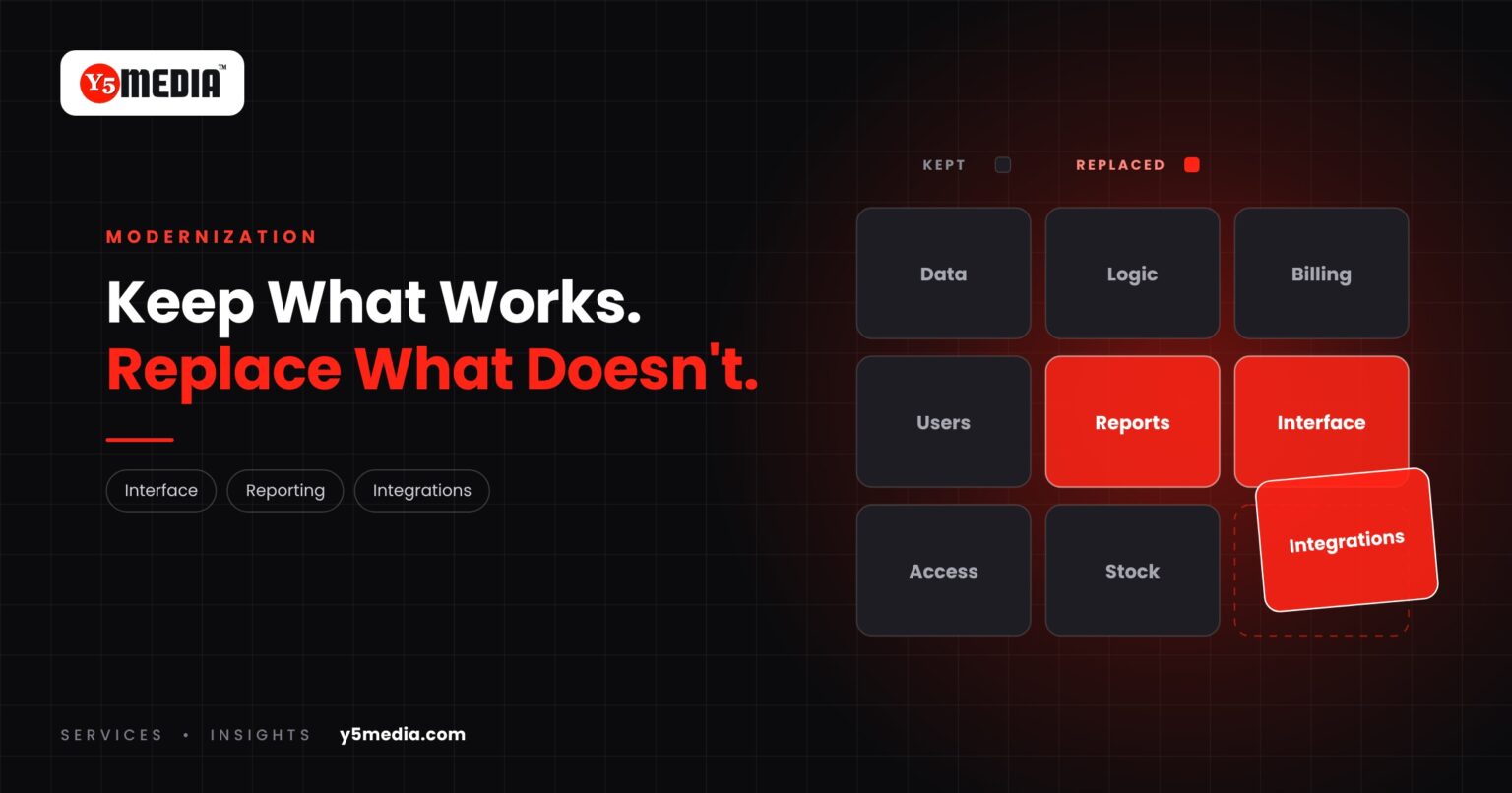
“Modernization” sounds like one large project. In practice it is a set of separate changes, and a business rarely needs all of them.
This guide sets out what software modernization services can actually consist of, how to choose between the pieces, and where the limits are.
What Modernization Can Involve
- UI improvements: screens redesigned so common tasks take fewer steps.
- Architecture changes: restructuring so one part can change without disturbing the rest.
- Database improvements: better structure, cleaner data, faster queries.
- API integration: letting the system exchange data with other software.
- Web access: making some or all functions available in a browser.
- Mobile access: giving field staff or managers what they need on a phone.
- Reporting: the reports people currently build by hand, produced by the system.
- Automation: removing repeated manual steps.
- Module redesign: rebuilding one weak module and leaving the others alone.
How to Choose
Start from the problem, not the list. Ask users what costs them the most time. Ask management what they cannot see. Then match each complaint to the smallest change that fixes it.
| Complaint | Smallest change that may fix it |
|---|---|
| “Month-end reports take days” | Reporting |
| “Branches cannot see each other’s data” | Web access, database improvements |
| “We type everything twice” | API integration, automation |
| “New staff cannot learn the screens” | UI improvements |
| “Every change breaks something else” | Architecture changes |
Often the answer is two or three items, not nine.
Why Phases Help
Modernizing in stages spreads cost and limits risk. Each stage delivers something usable, and the business keeps running on the existing system in between. It also means the plan can change as you learn.
The Limit
Not every system can be modernized. If the source code is unavailable, or the underlying technology is no longer supported, the options narrow and replacement may be the sounder route. Whether modernization is feasible, and how far it can go, is a question for a technical assessment. It cannot be judged from the outside.
Frequently Asked Questions
Do we have to stop using the system while it is modernized?
Normally not. Phased modernization is designed so the business keeps working on the existing system while improvements are built and tested alongside it. The details depend on the system and are part of the plan.
Which part should we modernize first?
The one that removes the most daily friction for the least change. Reporting and interface improvements are common starting points, but the right order comes from your users’ complaints and the assessment findings.
Is modernization possible without the source code?
It is limited. Some improvements can be made around a system, such as reporting from its database or integrations at its edges, but changing the application itself needs the code. An assessment will show what is realistic.
What to Remember
- Modernization is a menu of separate changes, not one project.
- Match each real complaint to the smallest change that resolves it.
- Most businesses need two or three items, not all nine.
- Phasing spreads cost, limits risk and keeps the business running.
- Feasibility depends on the system and has to be assessed.
How Y5MEDIA Approaches Modernization
We assess the existing system before deciding what to change. Our case study on school and college ERP modernisation and migration describes this on real work: carrying existing data and the features staff depend on into a more modern system.
If you are still deciding whether to modernize at all, read assess before you replace.
ERP Modernisation Case Study
How outdated school and college ERP systems are modernised or migrated with data carried across.
Learn more →Our Process
How an engagement runs, from first conversation to handover.
Learn more →Migration Services
Sites, mailboxes, databases and applications moved with staging, backup and a planned cutover.
Learn more →What Would You Keep, and What Would You Replace?
Tell us what works in your current system and what is holding the business back. We will assess it before recommending what to change.