
“Can you add Arabic?” is one of the most common requests a web developer hears from a UAE client, and usually it arrives after the English site has been designed, built and signed off. At that point the honest answer is: yes, but it would have been half the work if we had planned for it.
Language is a structural decision. It affects layout, navigation, URLs, search visibility, forms and how much it costs to keep the site current. This guide helps you decide whether you need one language or two, and explains what a proper bilingual build involves so you can brief a supplier with confidence.
The decision is about audience, not prestige
Arabic is the official language of the UAE. English is the everyday working language of much of its private sector. Neither fact alone tells you what your website needs. What matters is who you are trying to reach and what they expect.
| If your main audience is… | Usually appropriate | Why |
|---|---|---|
| Private-sector B2B buyers, mostly expatriate staff | English, with Arabic considered later | Procurement and operations teams generally work in English |
| Government entities and semi-government organisations | Arabic and English | Arabic is expected in official dealings, and supplier documentation is often reviewed in both |
| Emirati and wider Arab consumers | Arabic first, English second | Customers are more comfortable buying in their own language |
| Mixed consumer base: retail, clinics, schools, real estate | Both, with equal care | Families and decision-makers within one household may prefer different languages |
| Export or re-export customers outside the Gulf | English, possibly with other languages | Arabic may not be the relevant second language at all |
If you are unsure, look at evidence you already have: the language of incoming WhatsApp messages, the language customers use on the phone, and the language settings reported in your website analytics. Ten minutes with that data is more reliable than a general rule.
Three levels of bilingual, and what each costs you
Bilingual does not have to mean every page in both languages from the start.
Level one: an Arabic landing section
A small set of Arabic pages covering who you are, what you offer and how to make contact. The remainder of the site stays in English. This suits B2B firms that occasionally need to show Arabic capability, and it is honest about what is and is not translated.
Level two: full mirror of core pages
Home, services, about, contact and key landing pages exist in both languages, with a language switcher that takes the visitor to the equivalent page. Blog posts and detailed resources may remain in one language. This is the practical choice for most consumer-facing businesses.
Level three: complete parity
Every page, form, confirmation message, email notification and downloadable document exists in both languages and is updated together. This is appropriate for government-facing organisations and larger brands. It roughly doubles the ongoing content workload, so it requires a firm commitment to maintaining it.
The worst outcome is a level-three promise delivered at level-one effort: a language switcher that leads to half-translated pages or to the home page. Visitors notice, and it looks worse than having no Arabic at all.
Right-to-left is a layout, not a text setting
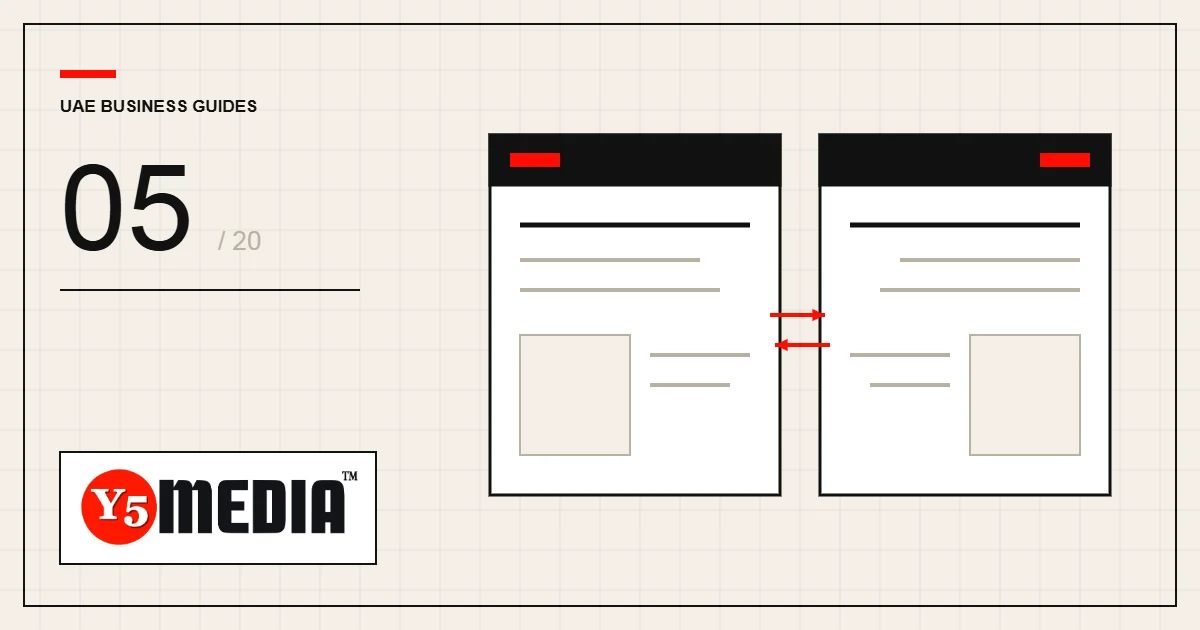
Arabic reads from right to left. On a properly built Arabic page, almost everything mirrors.
- Navigation starts from the right, and the logo typically moves to the right-hand side.
- Columns reverse. A text block on the left with an image on the right becomes the opposite.
- Directional icons flip. Arrows, chevrons and progress indicators point the other way.
- Forms align right, with labels and error messages positioned accordingly.
- Some things do not flip: phone numbers, embedded English brand names, video player controls and most charts.
Simply applying a right-to-left direction to an English template produces a page that is technically readable and visibly wrong. A proper build uses a stylesheet designed for both directions from the beginning. This is why adding Arabic late is expensive: the templates often have to be reworked.
Typography
Arabic script needs a typeface designed for it, larger line spacing than Latin text and usually a slightly larger font size to be equally legible. An English brand font will not contain Arabic letters, so the browser falls back to a default that may clash with your design. Choose an Arabic typeface deliberately and test it on a phone.
Translation: where bilingual sites succeed or fail
Machine translation has improved enormously, and it is a reasonable first draft. It is not a finished product for a business website. Service descriptions, legal wording and calls to action carry nuance, and awkward or overly literal Arabic is immediately apparent to a native reader.
A workable process is:
- Finalise the English first. Translating text that is still changing wastes money.
- Translate with a professional or a strong first-draft tool.
- Have a native speaker who understands your industry review every page. This is the step that matters most.
- Agree a glossary. Decide once how product names, technical terms and your company name are written in Arabic, and apply it everywhere.
- Review the pages in the browser, not only in a document. Line breaks, buttons and headings behave differently in layout.
Decide, too, which form of Arabic you are writing. Modern Standard Arabic is the norm for business websites. A Gulf conversational tone may suit social media but is rarely appropriate for service pages.
URLs, search engines and the language switcher
Give each language its own address
Each language version of a page should have its own URL, most commonly in a sub-folder such as /ar/ for Arabic. Avoid setups where the language changes on the same URL according to a cookie or browser setting. Search engines cannot index those reliably, and visitors cannot share a link to the version they were reading.
Tell search engines the versions are related
Language annotations, known as hreflang tags, tell search engines that the English and Arabic pages are equivalents and which to show to which searcher. Without them, the two versions may compete with each other or the wrong one may appear in results.
Research Arabic search terms separately
People do not search in Arabic using literal translations of English keywords. They use different phrases, and frequently mix Arabic and English, or type Arabic words in Latin characters. The headings and page titles on your Arabic pages should reflect how people actually search, which means separate research, not translation of your English keyword list.
Make the switcher predictable
The language switcher should appear in the same place on every page, show the name of the other language written in that language, and take the visitor to the equivalent page. Do not use flags. Languages are not countries.
The parts people forget
- Form confirmations and automatic emails. An Arabic form that sends an English auto-reply breaks the experience.
- Error messages and validation text.
- Cookie and privacy notices.
- Image text. Any wording baked into a banner graphic needs an Arabic version of the graphic.
- PDF brochures and price lists linked from the page.
- Map and directory listings, which can carry descriptions in more than one language.
- Who answers. If an enquiry arrives in Arabic, someone must be able to reply in Arabic.
That final point is the real test of readiness. A bilingual website is a promise about how you will communicate after the click.
How Y5MEDIA handles bilingual projects
Y5MEDIA builds bilingual websites on WordPress with a proper right-to-left stylesheet, separate URLs for each language, language annotations for search engines and a consistent switcher. We plan both directions at the design stage, even when the second language will be launched later, so that adding it does not mean rebuilding.
On translation, we are clear about our role. We are an India-based team working remotely with UAE clients. We prepare the content structure and can coordinate first-draft translation, and we ask every client to nominate a native reviewer, either in-house or a professional translator, who signs off the final wording. We will not publish local-language pages that no native reader has checked.
If you already have an English site and want to know what adding a second language would involve, the starting point is a review of your templates. See our WordPress development page for how we work, and our search engine optimisation service for the keyword research side. If the site would need restructuring or moving to accommodate it, our WordPress migration service covers that.
Frequently Asked Questions
Is an Arabic website legally required for a UAE business?
Requirements vary by sector and by the entities you deal with, and some regulated activities have specific language obligations. For anything regulatory, check with the relevant authority or a legal adviser. This article addresses the commercial and technical decision only.
Can we launch in English and add Arabic later?
Yes, provided the site is built with both directions in mind from the start. Tell your developer at the outset so templates are prepared for right-to-left layout.
Will a translation plugin that converts the page automatically be enough?
It is better than nothing for basic comprehension, but automatic on-the-fly translation is usually not indexed properly by search engines and often reads unnaturally. For pages that sell your services, reviewed human-quality translation is worth the cost.
Do we need separate domains for each language?
No. Sub-folders on one domain, such as /ar/, are the simplest approach for most businesses and keep your search authority in one place.
How much longer does a bilingual build take?
It depends on the level you choose and how quickly translations are reviewed. The review step, not the development, is usually what determines the timeline.
Plan the Second Language Before You Build
Share your current site or your brief. We will tell you which level of bilingual content suits your audience and what the build and upkeep would involve.