
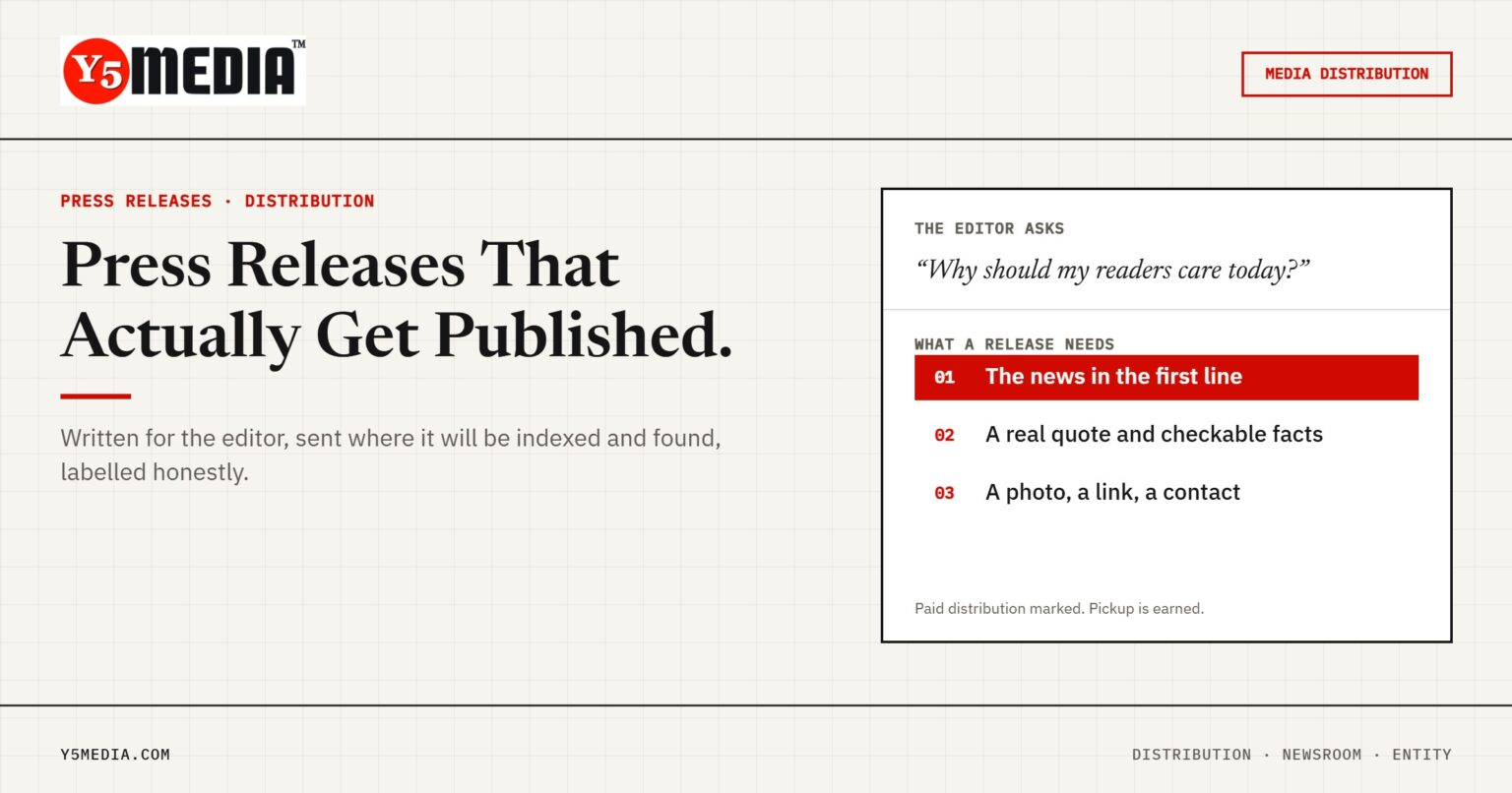
Most press releases are deleted unread. Not because the business is uninteresting, but because the release was written for the business rather than for the editor who receives it. A press release that gets published answers one question in the first line: why should this outlet’s readers care today? Media distribution is the work of writing to that standard and sending it through channels where it will be published, indexed and found.
This article covers what editors want, what search engines and AI assistants take from a published release, and how Y5MEDIA handles distribution for businesses in India and the Gulf.
What editors actually want
- The news in the headline and first sentence. Who, what, where, why it matters. No preamble.
- A reason it matters to their readers, not to your shareholders.
- A real quote that says something, from a named person with a title.
- Facts that can be checked: numbers with sources, dates, locations, names.
- Usable assets: a photo with a caption, a logo, a link, a contact who answers the phone.
- Short. One page. Background in a boilerplate paragraph at the end.
What search engines and AI assistants take from it
A published release on a credible site is a dated, third-party, indexed record of a fact about your business. It confirms your entity, adds a source an assistant can cite, and often earns a link. That is why the channel matters: a release that only sits on your own site is a blog post; a release published on news and industry portals is evidence.
How Y5MEDIA handles media distribution
- Newsworthiness check. Honest advice on whether this is news, and if not, what would be.
- Writing to standard. Headline, lead, quote, facts, boilerplate, assets. Reviewed by you before it goes anywhere.
- Channel selection. Wire and distribution services, news sites and industry portals relevant to your sector and markets, in India, the Gulf or both.
- Clear labelling. Where distribution is paid, it is marked as such. Editorial pickup is pursued separately through targeted outreach.
- Record and link. Every publication logged, linked from your newsroom page, and reflected in your entity record.
- Report. Where it was published, what it linked to, and any coverage or enquiries that followed.
What we will not promise
We cannot promise that a journalist picks up a release; that is their decision. We can promise a release written to the standard editors expect, sent through channels where it will be published and indexed, and an honest account of where it appeared.
Frequently Asked Questions
What is the difference between distribution and PR?
Distribution sends a release through channels where it will be published. Digital PR is the wider work of earning editorial coverage through stories and outreach. Y5MEDIA does both and labels them clearly.
Will our release appear on major news sites?
Distribution services place releases on their partner networks, which vary by service and region. Editorial coverage on major outlets is earned, not bought, and is pursued through outreach.
How often should we send releases?
When there is news. Monthly releases with nothing to say damage credibility; four genuine announcements a year do more.
Do you write the release?
Yes, from a short briefing with you, with your approval before distribution.
Does this help AI visibility?
Yes. Published releases are dated third-party records that assistants can cross-check and cite, and they strengthen your entity.
Write It for the Editor. Send It Where It Will Be Read.
Tell us what has happened in your business this quarter and we will tell you which of it is news, and where it belongs. Email support@y5media.com or message us on WhatsApp.