
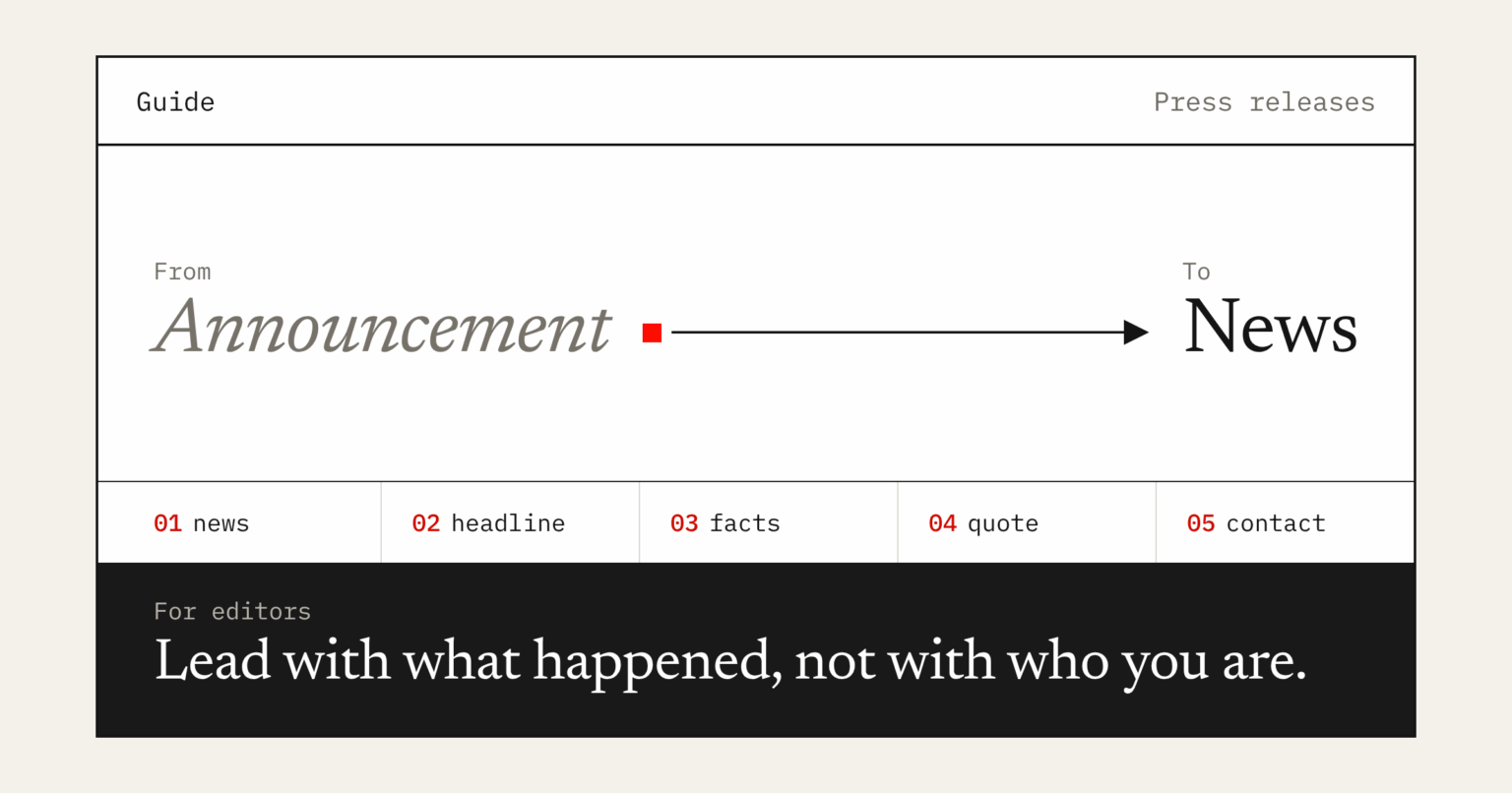
A journalist’s inbox fills faster than it can be read. Most press releases are judged on the subject line and the first sentence, and most are deleted, not because the company is unimportant but because the release never says what happened.
Knowing how to write a press release is mostly knowing what editors need and giving it to them quickly. This guide covers the test to apply before writing, the structure, the mistakes that get releases ignored and what to expect afterwards.
First, Is It News?
A press release announces something that has happened or is about to. Before writing, ask whether a stranger would find it worth knowing.
- Usually news: a launch, an opening, an appointment, a partnership, research findings, a significant milestone, a response to a public issue.
- Usually not news: a redesigned website, a general description of your services, an anniversary nobody else marks, an opinion with nothing attached to it.
If it is not news, it may still make a good article for your own site. Sending it as a release only teaches journalists to skip your name.
The Six Parts of a Press Release
| Part | What it should do |
|---|---|
| Headline | Say what happened, in plain words. No puns, no superlatives. |
| Opening paragraph | Who, what, when, where and why, in two sentences. If only this were printed, the reader would still have the story. |
| Supporting detail | Facts, figures and context, in descending order of importance. |
| Quote | A named person saying something a person would actually say. |
| About the organization | Three or four factual sentences. The same wording every time. |
| Contact | A named person, with a phone number and email that will be answered. |
Aim for one page. If a journalist needs more, they will ask, which is the outcome you want.
The Quote
Most quotes in press releases could have been written by anyone about anything: “We are delighted to announce this exciting milestone in our journey.” A journalist cannot use that.
A usable quote adds something the facts do not: a reason, a consequence, a point of view. Compare: “Parents told us they were spending an hour in a queue to pay fees. From June they can do it from a phone in two minutes.” It is specific, it sounds like speech, and it explains why the news matters.
Mistakes That Get Releases Ignored
- Superlatives. “Leading”, “revolutionary”, “world-class”. Editors remove them or stop reading.
- Buried news. Three paragraphs of background before the announcement.
- Unsupported claims. “The first” or “the largest” without evidence.
- Jargon. Terms only your industry understands.
- No date. The reader cannot tell whether it is current.
- Nobody to call. Or a contact who does not answer.
- Heavy attachments. Put the text in the email, and link to images.
Accuracy Is Not Optional
Everything in a release may be repeated in print under your name. Check every figure, title and spelling. Do not claim awards, clients, partnerships or results you cannot substantiate, and do not attribute quotes to people who have not approved them. A correction after publication does more harm than the release did good.
Sending It
- Send it to journalists who cover the subject, not to every address you can find.
- Write a short personal note saying why it is relevant to them.
- Use a subject line that states the news.
- Be available on the day. A reply within the hour is often what secures the piece.
- Follow up once, briefly. Then leave it.
A distribution service can place the release on news and aggregator sites as well. That is a different thing from a journalist choosing to report it, as explained in paid, sponsored or earned.
Honest Expectations
A well-written release about real news improves the odds. It does not guarantee coverage, and no provider can promise that a particular publication will run it. Publish the release on your own website as well, so that the announcement is on record whatever the press decides. See also digital PR and content syndication.
Frequently Asked Questions
How long should a press release be?
About a page, or three to five hundred words. Long enough for the facts, short enough to be read.
When is the best time to send one?
On a working day, in the morning, and not just before a public holiday. Relevance matters far more than the hour.
Should images be included?
Yes, offered by link: a good photograph with a caption and permission to use it makes a piece easier to run.
Can a press release help with search visibility?
It puts accurate information about you on record and can be found. It should not be relied on as a source of ranking benefit.
What to Remember
- If it is not news, do not send it as a release.
- Put the whole story in the first two sentences.
- Write a quote a person would actually say.
- Check every fact, and claim nothing you cannot support.
- Coverage can be made more likely. It cannot be guaranteed.
How Y5MEDIA Approaches This
Personal Branding, Reputation Management and Digital PR is a selective Y5MEDIA Premium service for people and organizations acting lawfully and honestly. Reputation work is taken on only where someone is the target of false news, false comments or fake reviews. We do not help anyone suppress genuine criticism. It starts with an assessment of the facts, the scope is agreed in writing, and it does not include guaranteed rankings, removals or media coverage.
Personal Branding and Reputation
A selective Y5MEDIA Premium service for people and organizations whose name matters.
Learn more →AI Visibility Management
How your brand appears in search results and in AI answers.
Learn more →Digital PR Distributions
Announcements and expert content distributed through relevant channels.
Learn more →Have News Worth Announcing?
Tell us what has happened and who should know. We will tell you plainly whether it is news, and how best to present it. Engagements are accepted after a suitability review.
Call or WhatsApp +91 7902024242, email support@y5media.com, or use the contact page.