
Someone searches your name or your company’s, and there it is on the first page: an old article, a hostile post, a complaint from years ago. The first instinct is to ask how to get rid of it. The second is to search for a company that promises to.
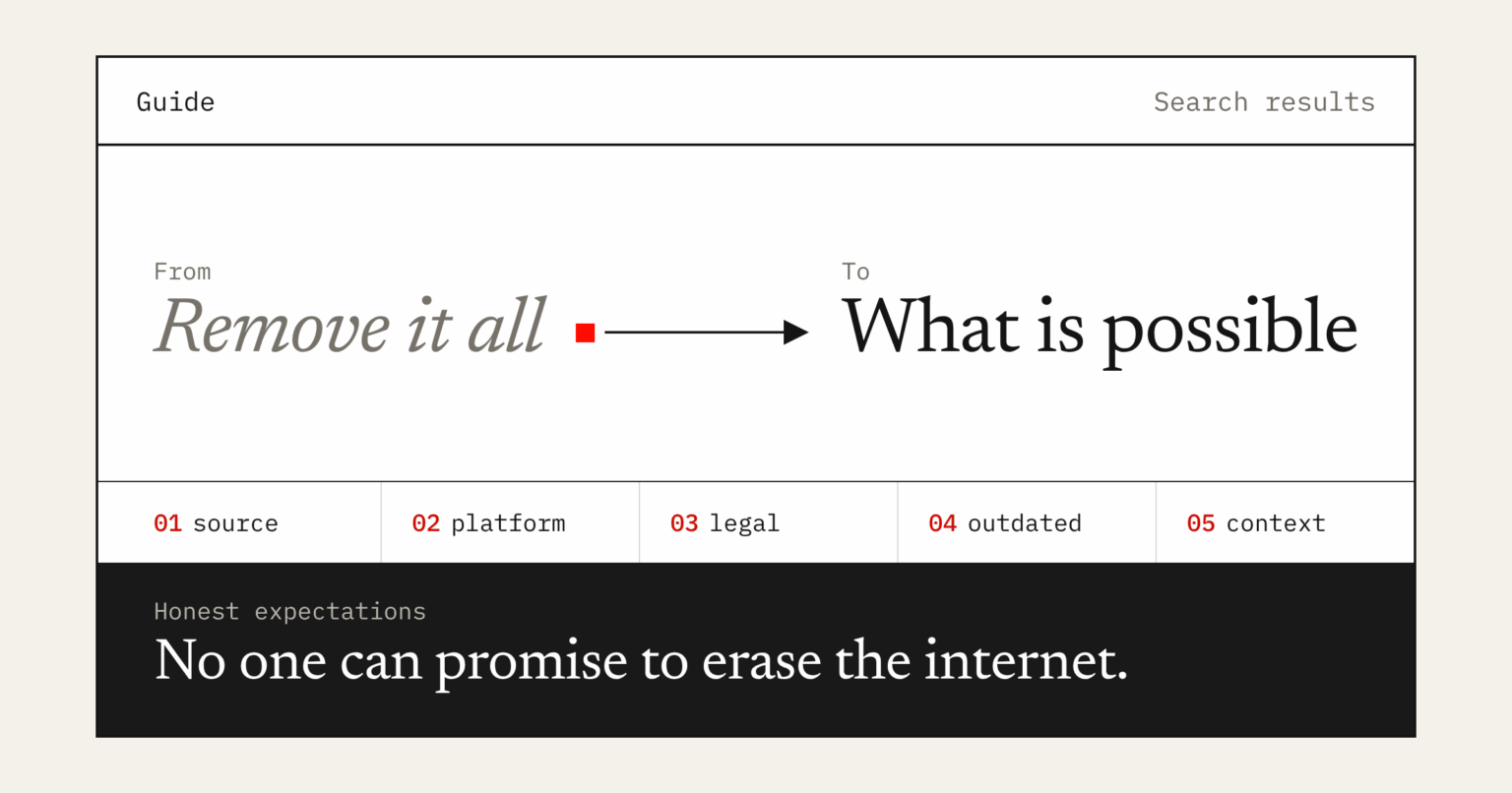
The honest answer about negative search results is that some can be removed, many cannot, and anyone who guarantees removal before looking at the facts is selling something they do not control. This guide explains what is realistically possible. It is general information, not legal advice.
Who Controls a Search Result?
A search engine shows pages that exist elsewhere. So there are two separate questions: can the page itself be changed or taken down, and can the search engine be asked to stop showing it? Different parties control each, which is why there is no single switch.
Four Legitimate Routes
| Route | When it applies | Who decides |
|---|---|---|
| Ask the publisher | The content is factually wrong, out of date, or the matter has since been resolved. | The site’s owner or editor. |
| Use the platform’s rules | The content breaks the policies of the site hosting it: impersonation, harassment, spam, a review of the wrong business. | The platform. |
| Ask the search engine | Specific categories, such as certain personal information, or pages that have already been changed or deleted at the source. | The search engine. |
| Legal action | The content is unlawful, for example defamatory, or infringes your rights. | A court, on legal advice. |
Each takes time, each needs evidence, and each can end in a refusal. A polite, well-documented request to a publisher succeeds more often than people expect, particularly for plain factual errors.
What Generally Cannot Be Removed
- Accurate news reporting on matters of public interest.
- Genuine reviews from real customers, however unwelcome.
- Public and official records published lawfully.
- Opinions honestly held and expressed as opinion.
That it is damaging is not, by itself, a ground for removal. The rules differ between countries and change over time, so a lawyer should be consulted where the stakes are high.
What Can Be Done Instead
When a result cannot be removed, the context around it can still change.
- Respond where it is appropriate. A calm reply to a review, or a correction requested from a publisher.
- Fix what was true. If the criticism had substance, addressing it is the only lasting answer.
- Publish accurate, useful material. Current profiles, real work, articles and announcements, so that a searcher sees the whole picture and not a single old item.
- Keep your own pages strong. Your website and main profiles should be the most complete and current sources about you.
- Give it time. Old items tend to matter less as newer, relevant material accumulates.
This is slower than deletion and cannot be guaranteed to move any particular result. It is, however, entirely legitimate and within your control. A personal online reputation audit is the place to begin.
Warning Signs in a Provider
- Guaranteed removal, especially with a fixed time.
- Refusal to explain the method.
- False legal or copyright complaints filed to trick a platform into taking content down.
- Fake reviews or fake articles created to bury the result.
- Threatening the author on your behalf.
- Payment only to “the site” through the provider, with no evidence of what was paid for.
Several of these are unlawful as well as unethical, and when they are exposed the story becomes worse than the one you set out to bury.
Where Y5MEDIA Stands
We take on reputation work only for lawful, honest people and organizations who are the target of false news, false comments or fake reviews. If the criticism is genuine, or the conduct behind it is unlawful, we do not take the work and we do not intervene.
Our Personal Branding and Reputation Management service begins with the facts and a suitability review, and it does not include guaranteed removals. The details are in our client acceptance and ethical standards.
Frequently Asked Questions
Can I pay a search engine to remove a result?
No. Search engines do not sell removals. Requests are assessed against their published policies.
How long does a removal request take?
It varies from days to months, depending on the route and who has to decide. Legal routes take longest.
Will the result come back?
It can, if the content is republished elsewhere. This is one reason building accurate material of your own matters.
Is it illegal for someone to post something negative about me?
Not if it is true or honest opinion. False statements that damage your reputation may be actionable. A lawyer can advise on your specific case.
What to Remember
- Some results can be removed. Many cannot.
- The four routes are the publisher, the platform, the search engine and the courts.
- True, lawful content generally stays.
- Accurate, current material changes the context over time.
- Guaranteed removal is a warning sign, not a service.
How Y5MEDIA Approaches This
Personal Branding, Reputation Management and Digital PR is a selective Y5MEDIA Premium service for people and organizations acting lawfully and honestly. Reputation work is taken on only where someone is the target of false news, false comments or fake reviews. We do not help anyone suppress genuine criticism. It starts with an assessment of the facts, the scope is agreed in writing, and it does not include guaranteed rankings, removals or media coverage.
Personal Branding and Reputation
A selective Y5MEDIA Premium service for people and organizations whose name matters.
Learn more →AI Visibility Management
How your brand appears in search results and in AI answers.
Learn more →Digital PR Distributions
Announcements and expert content distributed through relevant channels.
Learn more →Concerned About a Search Result?
Tell us what appears and what the facts are. We will tell you plainly which routes are open, which are not, and what honest work could change. Engagements are accepted after a suitability review.
Call or WhatsApp +91 7902024242, email support@y5media.com, or use the contact page.