
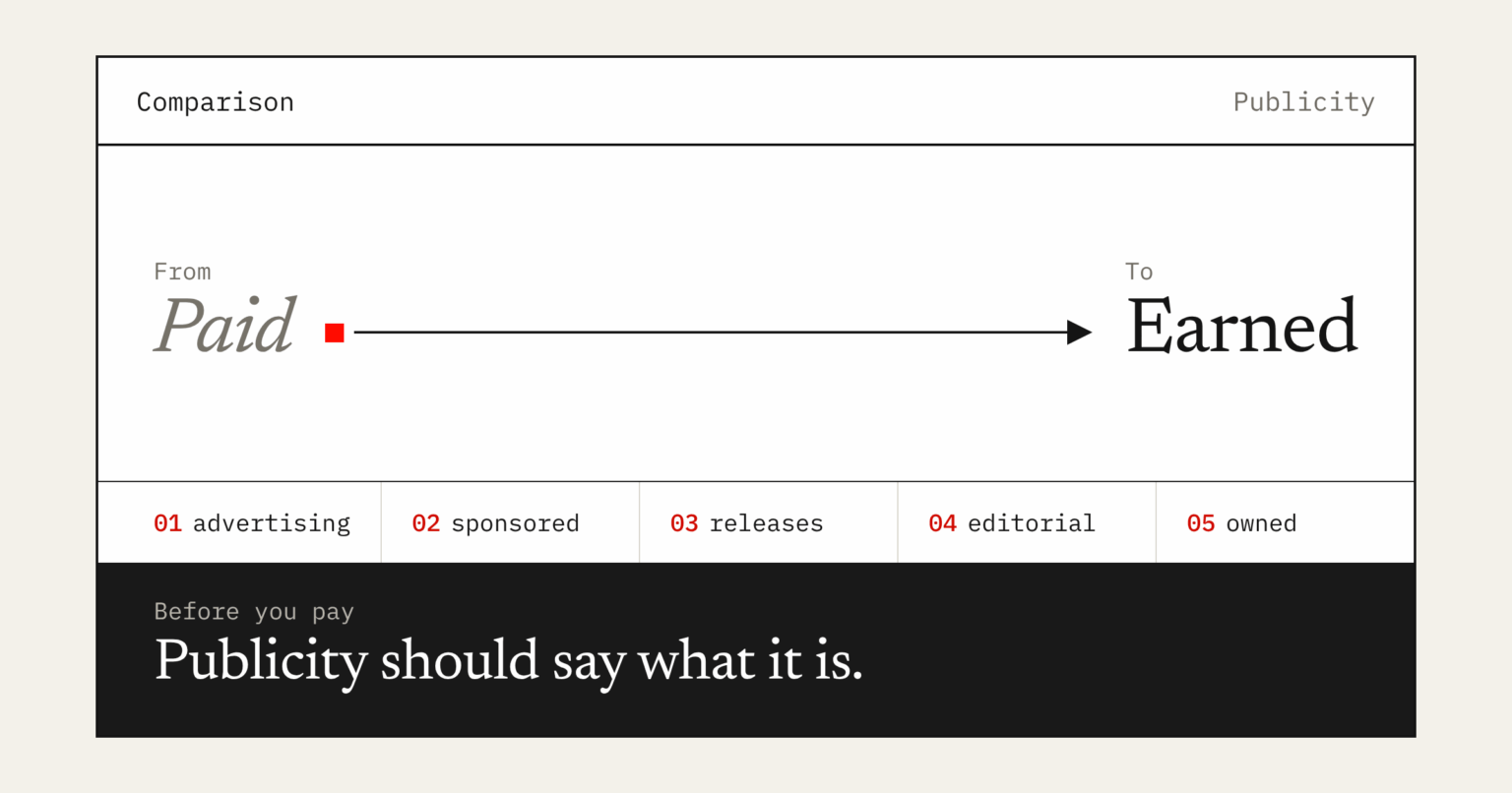
A business owner is offered “guaranteed coverage in leading publications” for a fixed fee. A fortnight later a link arrives. The article is there, under the publication’s name, and the owner adds an “As featured in” banner to the website. What was actually bought, and what do readers and search engines make of it?
Understanding paid vs earned media is the difference between spending wisely on publicity and paying for something that looks like more than it is. This guide sets out the kinds of publicity, what each is good for and the questions to ask before you pay.
Five Kinds of Publicity
| Kind | What it is | Who decides it appears | Can it be guaranteed? |
|---|---|---|---|
| Advertising | Space or time you pay for, clearly shown as an advertisement. | You, by paying. | Yes. |
| Sponsored content | An article or feature you pay to have published, which should be labelled as sponsored or as a partner feature. | You, by paying. | Yes. |
| Press release distribution | Your announcement sent out through a distribution service and republished on news and aggregator sites. | You, by paying for distribution. | Distribution, yes. A journalist writing about it, no. |
| Earned coverage | A journalist or editor chooses to write about you because it serves their readers. | The journalist or editor. | No. |
| Owned media | Your website, newsletter and profiles. | You. | Yes. |
None of these is illegitimate. Each has a proper use. Trouble begins only when one is presented as another.
Why the Difference Matters
To readers. People weigh an independent journalist’s judgement differently from a message the subject paid for. That is the whole value of editorial coverage, and the reason paid content is expected to be labelled.
To search engines. Search engines expect paid links to be marked as such and treat them differently from independent ones. A hundred syndicated copies of a press release are not a hundred endorsements.
To you. If you believe you bought editorial coverage and you bought a paid placement, you will misjudge both what it is worth and how to describe it.
The “As Featured In” Problem
A row of well-known publication logos suggests that those publications chose to write about you. If what really happened is that a paid release was republished automatically in a section of their site, the banner creates a false impression.
An accurate version is always available: “Press release published on…” or “Sponsored feature in…”. It is less impressive, it is true, and it cannot be turned against you later.
Questions to Ask a PR Provider
- Is this a paid placement, a distributed release or a pitch to journalists?
- Will it be labelled as sponsored, and where will it appear on the site?
- Who writes it, and who has final approval?
- If you are pitching to journalists, what happens if nobody takes it up?
- How long will the piece stay online?
- How will results be reported, and what will not be claimed?
A provider who promises editorial coverage in a named publication, for a fee, is either selling a paid placement under another name or promising a decision that belongs to an editor.
What Each Kind Is Good For
- Advertising reaches a defined audience on a schedule you choose.
- Sponsored content lets you explain something at length to a publication’s readers, openly.
- Distributed releases put a formal announcement on record and make it findable.
- Earned coverage carries the most credibility and is the least predictable.
- Owned media is the foundation, since everything else points back to it.
A sensible programme uses several of these, described honestly. Our article on digital PR and content syndication looks at distribution in more detail, and how to write a press release covers the announcement itself.
Earning Coverage
Earned coverage cannot be bought and it can be made more likely: by having real news, by offering expertise a journalist can use, by answering promptly and by being a reliable source over time. Nobody can guarantee it, which is precisely why it is worth having.
Frequently Asked Questions
Is sponsored content dishonest?
No, provided it is labelled. It becomes misleading only when it is passed off as independent reporting.
Does a press release count as media coverage?
A published release is a published announcement. It is coverage in the sense that it appears on a site, and it is not the same as a journalist choosing to report on you.
Can anyone guarantee an article in a major publication?
Only as a paid placement. Editorial decisions belong to editors.
Which kind should a small business start with?
Owned media first: a clear website and current profiles. The rest works better when there is something solid to point to.
What to Remember
- Advertising, sponsored content, distribution, earned coverage and owned media are different things.
- All are legitimate when described accurately.
- Earned coverage cannot be guaranteed by anyone.
- “As featured in” should mean what readers think it means.
- Ask exactly what you are buying before you pay.
How Y5MEDIA Approaches This
Personal Branding, Reputation Management and Digital PR is a selective Y5MEDIA Premium service for people and organizations acting lawfully and honestly. Reputation work is taken on only where someone is the target of false news, false comments or fake reviews. We do not help anyone suppress genuine criticism. It starts with an assessment of the facts, the scope is agreed in writing, and it does not include guaranteed rankings, removals or media coverage.
Personal Branding and Reputation
A selective Y5MEDIA Premium service for people and organizations whose name matters.
Learn more →AI Visibility Management
How your brand appears in search results and in AI answers.
Learn more →Digital PR Distributions
Announcements and expert content distributed through relevant channels.
Learn more →Planning Publicity and Want It Described Honestly?
Tell us what you want to announce and who should hear it. We plan publicity that says what it is, and engagements are accepted after a suitability review.
Call or WhatsApp +91 7902024242, email support@y5media.com, or use the contact page.