
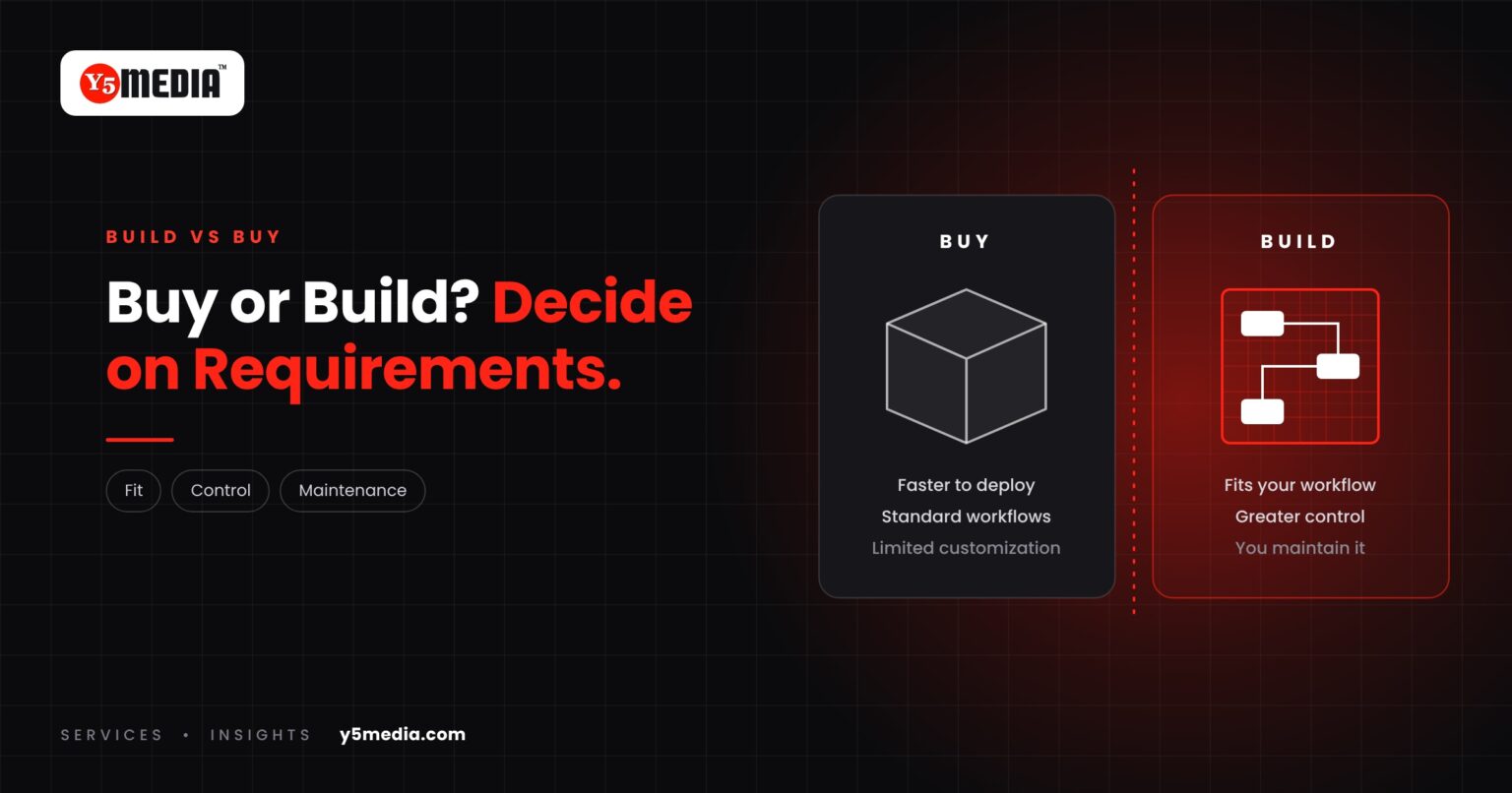
There is no universal answer to this question, and anyone who gives you one before hearing your requirements is selling something.
The build vs buy software decision is better treated as a requirements question than a matter of belief. Here is a neutral way to think it through.
Buy and Build Compared
| Buy | Build | |
|---|---|---|
| Speed | Faster initial deployment | Time before the system is usable |
| Fit | Standard workflows; your process bends to the product | Workflows designed around your business |
| Cost pattern | Subscription or licence, ongoing | Higher initial development effort |
| Control | Dependent on the vendor’s roadmap and pricing | Greater control over features and data |
| Integrations | Whatever the product supports | Built to your own systems |
| Maintenance | Handled by the vendor | Your responsibility for the life of the system |
Five Questions That Usually Settle It
- Is your process standard or specific? If it matches how most businesses in your sector work, a product probably exists.
- Is the process a differentiator? If it is how you compete, bending it to a product has a real cost.
- What must it connect to? Hard integration requirements often tip the decision.
- How fast do you need it? Urgency favours buying.
- Who will maintain it? Built software needs an owner for its whole life.
The Middle Ground
It is not always either-or. Many businesses buy a core product and build around it: a custom module, a reporting layer, or an integration that joins two products together.
Our View
If a packaged product meets your requirements, buy it. Custom software earns its place when the requirement is specific enough that no product fits without constant workarounds. If you are not sure which side you are on, the six signs are a good starting point.
Frequently Asked Questions
Is custom software always more expensive?
It usually costs more at the start and needs ongoing maintenance. Packaged software costs less up front but carries licence fees for as long as you use it, plus the cost of any workarounds. The comparison only makes sense over several years and against your actual requirements.
Can we switch from bought to built later?
Yes, and many businesses do. Starting with a product is a reasonable way to learn what you really need. Plan for the data to be exportable so a later move is practical.
What should be written down before we decide?
The workflow as it actually runs, the systems it must connect to, the reports you need, who will use it, and what must be true a few years from now. Without that list, neither option can be judged fairly.
What to Remember
- Build vs buy is a requirements question, not a matter of belief.
- Buying gives speed and vendor-run maintenance; building gives fit and control.
- Five questions settle most cases: standard or specific, differentiator, integrations, urgency, ownership.
- A bought core with custom pieces around it is often the practical answer.
- If a product fits, buy it.
How Y5MEDIA Helps With the Decision
We help you evaluate the technical requirements before development begins. That means writing down the workflow, the integrations and the constraints, then comparing the routes honestly.
If a packaged product fits, we will say so. Our process explains how an engagement starts.
Our Process
How an engagement runs, from first conversation to handover.
Learn more →WordPress Development
Custom functionality and integrations, built and documented so others can maintain them.
Learn more →ERP Implementation Case Study
Lessons from connecting a large, decentralised education network on one ERP ecosystem.
Learn more →Buying or Building? Start With the Requirements.
Share what the software has to do and what it must connect to. We will help you evaluate the technical requirements before any development begins.