
Every growing business reaches the point where the spreadsheet has a spreadsheet, three tools hold three versions of the same customer, and one person knows how it all fits together. That is not a failure. It is what success looks like just before it becomes expensive.
This article lists the signs that you have outgrown off-the-shelf tools, explains the difference between buying, integrating and building, and describes how Y5MEDIA approaches custom software: understand the problem first, then decide whether code is even the answer.
Seven signs you have outgrown your tools
- Double entry. The same order, student, patient or invoice is typed into two systems by hand.
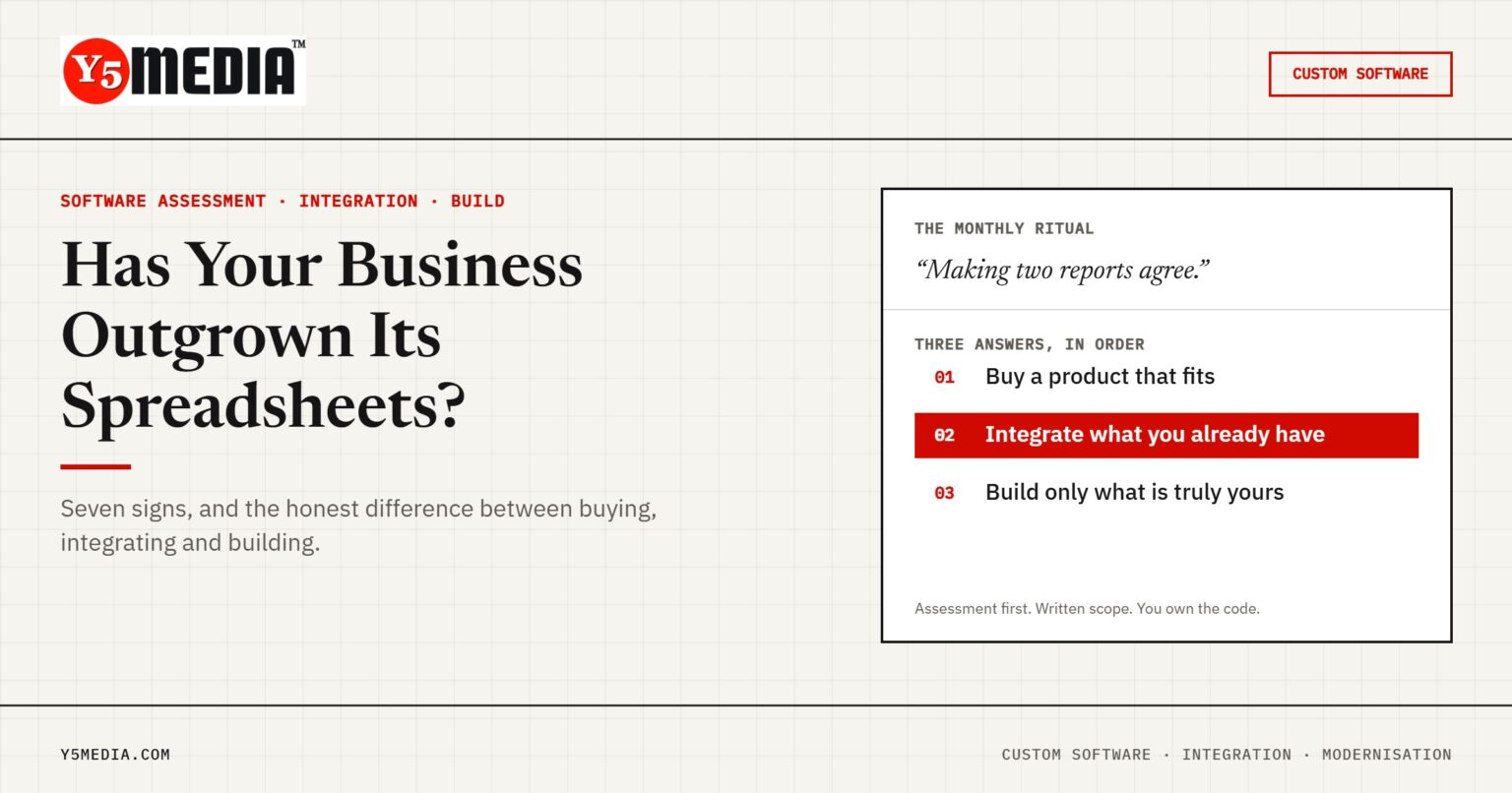
- The reconciliation ritual. Someone spends the first days of every month making two reports agree.
- One-person dependency. A single staff member understands the macros, the workarounds and the folder structure. Leave is a risk.
- Workarounds inside the tool. Fields repurposed for things they were never meant to hold; “notes” columns doing the work of a database.
- Reports built by export. Every management question is answered by exporting to Excel and rebuilding the same pivot table.
- Customers notice. Status queries you cannot answer quickly, confirmations sent late, errors that trace back to a copy-paste.
- The vendor cannot change it. The off-the-shelf product does 80% of the job and the remaining 20% is the part that matters to you.
Buy, integrate or build?
- Buy when a mature product does most of what you need and your process can reasonably adapt to it.
- Integrate when the tools are fine individually and the pain is in moving data between them. APIs, automation and a small middle layer often solve this at a fraction of the cost of a rebuild.
- Build when the process is genuinely yours, when it is your competitive edge, or when no product fits without breaking the way you work. Build small, document everything, and keep ownership of the code.
How Y5MEDIA approaches custom software
- Software assessment. We sit with the people doing the work, trace the data, and write down what the system actually needs to do. This is where buy-integrate-build is decided.
- Written scope. Features, exclusions, timeline and cost in writing before anything is built. Changes get a change note, not a surprise invoice.
- Build in stages. The most painful workflow first, used by real staff, then the next. No twelve-month reveal.
- Integrate, do not isolate. New software talks to your accounting, messaging, website and existing tools rather than becoming another silo.
- Document and hand over. Code, configuration and a plain-English manual belong to you. The next developer, whether ours or someone else’s, can pick it up.
- Modernise rather than rewrite where an existing system is sound but old: migration, integration and interface work can extend its life without the risk of starting over.
What we will not claim
We will not quote a price before an assessment, promise a delivery date before a scope, or tell you a custom build is the answer before we have looked. Our background is in education ERP and business systems that have to work every day for years, and that experience is mostly a list of things to avoid.
Frequently Asked Questions
How much does custom software cost?
It depends entirely on scope, which is why we start with an assessment and give a written quote afterwards rather than a number that changes later.
Can you work with our existing systems?
Usually, yes. Integration is often the better answer than replacement, and most modern tools expose an API we can connect to.
Who owns the code?
You do. Source code, configuration and documentation are handed over, and nothing is locked to us.
Do you support the software after launch?
Yes, under a separate, optional maintenance agreement. It is never bundled into the build without your say-so.
We have an old system that works but is outdated. Do we have to replace it?
Not necessarily. Modernisation and migration can extend a sound system’s life with less risk than a rewrite. The assessment will tell you which is sensible.
Find Out Whether You Need Software at All
Book a software assessment. We will map the work, trace the data and tell you plainly whether to buy, integrate or build. Email support@y5media.com or message us on WhatsApp.