
It starts with one post, one video or one phone call from a reporter. Within an hour it is being shared. By the evening, staff are asking what to say and a customer has cancelled. The instinct is to respond at once and forcefully. That instinct is responsible for most of the damage that follows.
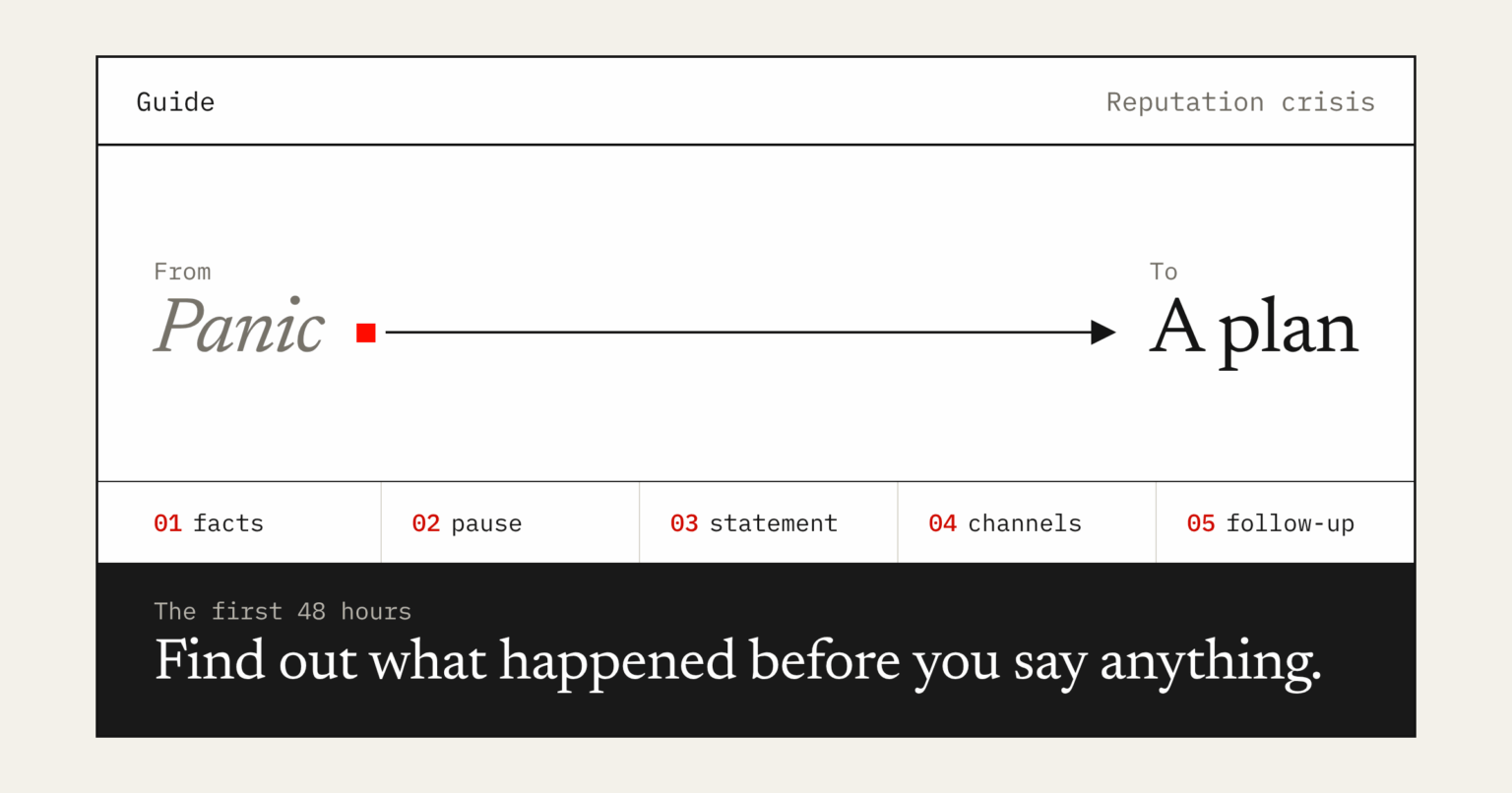
Reputation crisis management in the first forty-eight hours is largely about sequence: find out what happened, then decide what to say, then say it once and clearly. This guide sets out that sequence. It is general guidance, not legal advice.
The First Hour: Establish the Facts
You cannot respond well to something you do not yet understand. Before any statement:
- Find out exactly what is being said, where, and by whom.
- Find out what actually happened, from the people directly involved.
- Separate what you know from what you assume.
- Save copies and screenshots, with times.
- Tell your own staff first, briefly, and ask them not to comment publicly.
Pause What Was Scheduled
Stop scheduled social posts, promotional emails and advertisements until you know where things stand. A cheerful offer appearing in the middle of a serious complaint makes an organization look as though it is not paying attention.
One Voice
Name one person to speak for the organization and route everything through them. Conflicting replies from different members of staff, however well meant, become a second story.
The Holding Statement
You will rarely have all the facts in the first hours. A holding statement lets you say something true without saying too much.
| Element | Purpose |
|---|---|
| Acknowledge | Show that you are aware and that you take it seriously. |
| Say what you know | Only confirmed facts. Nothing speculative. |
| Say what you are doing | The steps under way to establish what happened or to put it right. |
| Say when you will say more | A time, which you then keep. |
If the organization is at fault, say so plainly once the facts are clear, and apologize without qualification. A sincere apology shortens a crisis. A grudging one extends it.
Where to Respond
Respond first in the place where the matter arose. If it began on one platform, answer there, then put the same statement on your own website and other channels. Speak directly and privately to the people affected wherever that is possible, before or alongside any public statement.
What Never to Do
- Do not delete genuine criticism. It is usually noticed, and it becomes the story.
- Do not argue in the comments.
- Do not blame the customer or a junior employee.
- Do not speculate about causes or about other people’s motives.
- Do not use fake accounts or paid commenters to defend yourself.
- Do not threaten legal action in public. If the law is relevant, take advice quietly.
- Do not say “no comment”. Say what you can, and when you will say more.
When to Take Legal Advice
Take it early if there is any possibility of injury, a data breach, a regulatory matter, an employment dispute or defamation. A lawyer’s job is to limit liability and a communicator’s is to keep trust. Good crisis handling needs both, working together and not in sequence.
After the First Forty-Eight Hours
- Give the update you promised, on time, even if it is brief.
- Do what you said you would do, and say when it is done.
- Correct the underlying problem. Communication cannot substitute for that.
- Review how it was handled, and write down what you would do differently.
- Prepare for next time: a named spokesperson, contact lists and a draft holding statement.
What people remember afterwards is rarely the incident. It is whether the organization was straight with them. For the slower work that follows, see online reputation management for business and can negative search results be removed?
What Cannot Be Promised
No approach guarantees that a crisis will pass quickly or without cost. Honest, prompt handling improves the outcome. It does not control what others choose to say.
Y5MEDIA assists in a reputation crisis only where the person or organization has acted lawfully and honestly and the claims being spread are false. Where criticism is deserved, the right response is to put the matter right, and publicity cannot do that for you.
Frequently Asked Questions
How quickly must we respond?
Acknowledge within hours. A full account can follow once the facts are established.
Should we respond if the claim is false?
Yes, calmly and with evidence, once. Repeated denials keep the claim in circulation.
Is it ever right to stay silent?
Occasionally, for a minor matter that is not spreading. Silence in the face of a serious, visible issue is usually read as indifference or guilt.
Who should speak for the organization?
For a serious matter, the most senior person available. People want to hear from someone with the authority to act.
What to Remember
- Establish the facts before saying anything.
- Pause scheduled promotion and appoint one voice.
- Use a holding statement: acknowledge, known facts, action, next update.
- Never delete, argue, blame or fake support.
- Fix the cause. Statements alone do not repair trust.
How Y5MEDIA Approaches This
Personal Branding, Reputation Management and Digital PR is a selective Y5MEDIA Premium service for people and organizations acting lawfully and honestly. Reputation work is taken on only where someone is the target of false news, false comments or fake reviews. We do not help anyone suppress genuine criticism. It starts with an assessment of the facts, the scope is agreed in writing, and it does not include guaranteed rankings, removals or media coverage.
Personal Branding and Reputation
A selective Y5MEDIA Premium service for people and organizations whose name matters.
Learn more →AI Visibility Management
How your brand appears in search results and in AI answers.
Learn more →Digital PR Distributions
Announcements and expert content distributed through relevant channels.
Learn more →Facing a Reputation Problem Right Now?
Tell us what has happened and where it is being discussed. We start with the facts, and engagements are accepted after a suitability review.
Call or WhatsApp +91 7902024242, email support@y5media.com, or use the contact page.