
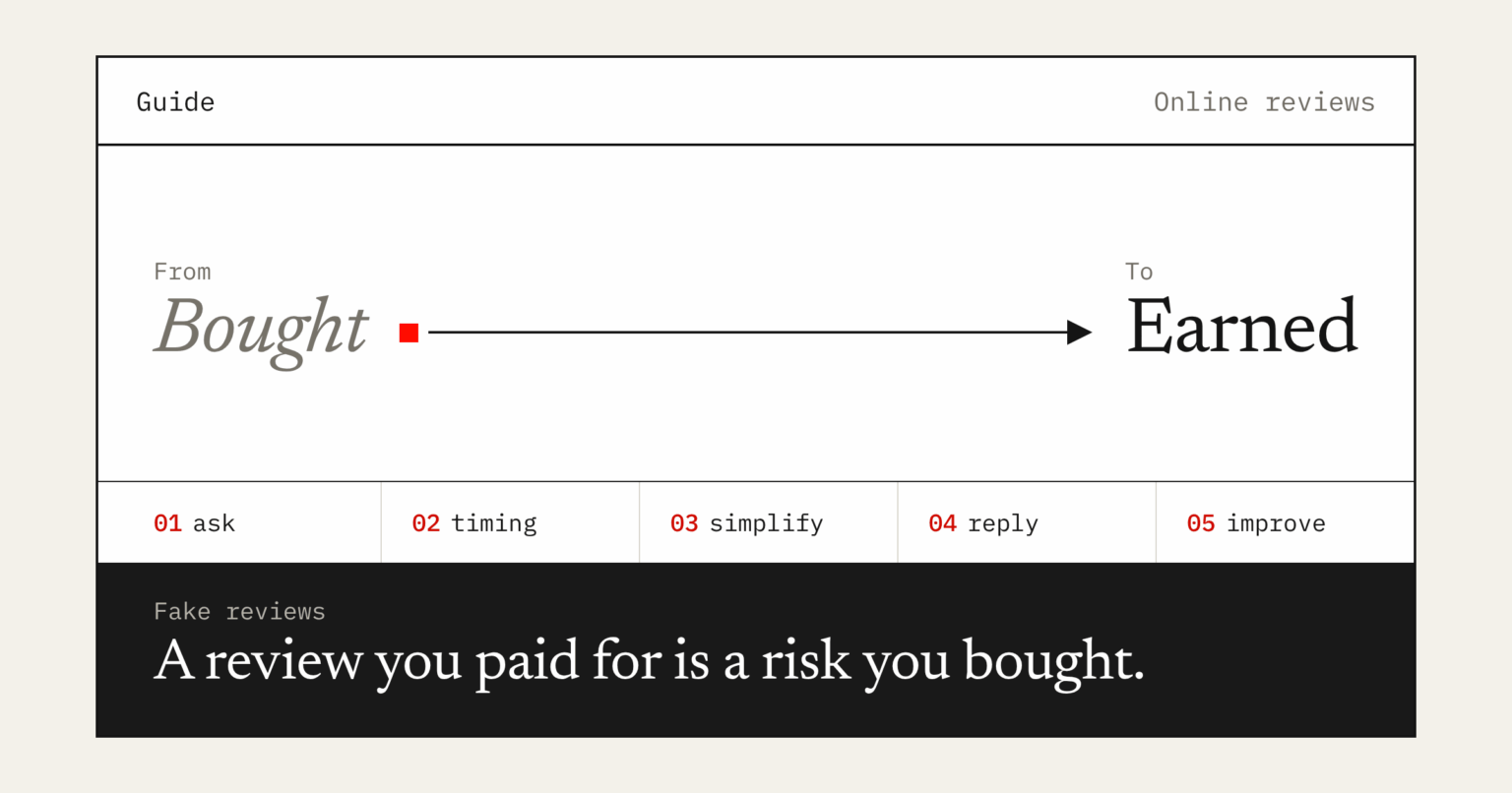
A competitor down the road has two hundred five-star reviews and you have nineteen. An email arrives offering fifty positive reviews by Friday for a modest fee. It is tempting, it is common, and it is one of the worst bargains in marketing.
Fake reviews are cheap to buy and expensive to own. This guide explains what counts as one, why they backfire, and the honest ways of earning more genuine reviews, which work better and last.
What Counts as a Fake Review
| Practice | Why it is a problem |
|---|---|
| Buying reviews | Written by people who never used the business. |
| Reviews by owners, staff or family | Presented as independent customers when they are not. |
| Rewards for positive reviews | A discount or gift given only for a good rating distorts what readers see. |
| Review gating | Asking how the experience was first, then sending only happy customers to the review page. |
| Negative reviews of competitors | Dishonest, and potentially unlawful. |
| Review swapping | Businesses agreeing to praise each other without being customers. |
Four Ways They Backfire
1. Platforms remove them, and more besides
Review platforms look for unnatural patterns: many reviews in a short time, reviewers with no history, similar wording. When they act they may remove genuine reviews along with the fake ones, restrict the listing or display a warning on it.
2. Customers notice
Readers have become good at spotting praise that is vague, repetitive or oddly timed. A perfect score with no detail persuades fewer people than a slightly lower one with real stories in it.
3. There may be legal consequences
Consumer protection rules in many countries, India included, can treat fake or misleading reviews as an unfair or deceptive practice. This is a general observation, not legal advice. The direction of regulation is towards more scrutiny, not less.
4. They hide what you need to know
Genuine reviews tell you what to fix. A wall of purchased praise leaves the real problem untouched and the next real customer just as disappointed.
How to Earn Genuine Reviews
- Ask every customer, not only the ones you expect to be pleased.
- Ask at the right moment, soon after a good outcome while the experience is fresh.
- Ask in person where you can. A sincere request from the person who served them works best.
- Make it easy. A direct link or a code to scan, so it takes a minute.
- Do not script it. Reviews in the customer’s own words are the ones others believe.
- Reply to all of them. People are more willing to write when they can see that reviews are read.
- Fix what the reviews keep mentioning. Better service is the only dependable source of better reviews.
Progress this way is slower than buying fifty in a week. It also accumulates, and it cannot be taken away.
Where the Line Is on Incentives
Many platforms prohibit offering anything in exchange for reviews, and nearly all prohibit rewards conditional on a positive rating. Check the rules of each platform you use. The safe course is to ask for honest feedback and offer nothing for it.
If You Receive Fake Negative Reviews
- Check your records to confirm that the reviewer was not a customer.
- Report the review through the platform’s own process, with your reasons.
- Reply once, calmly, saying you cannot find a record and inviting them to make contact.
- Keep copies, in case a pattern emerges.
- Do not retaliate. Answering fake with fake leaves you with two problems.
The platform decides whether a review is removed, and no provider can guarantee the outcome. For genuine complaints, see how to respond to negative reviews.
Where Y5MEDIA Stands
We do not write, buy or arrange fake reviews, for clients or against their competitors. That is set out in the client acceptance and ethical standards for our reputation work.
What we help with is the honest version, and only for lawful, genuine businesses: making it easy for real customers to leave reviews, responding to them well, and reporting fake reviews aimed at an honest business.
Frequently Asked Questions
Can we ask customers for reviews?
Yes. Asking for honest feedback is normal and welcome. Asking only for positive reviews, or rewarding them, is not.
Can staff ask friends to leave reviews?
Only if those friends are real customers writing about a real experience. Otherwise it is a fake review.
How many reviews do we need?
There is no fixed number. A steady flow of recent, detailed, genuine reviews matters more than a large total.
Our competitor clearly buys reviews. What can we do?
You can report specific reviews to the platform. Beyond that, the best answer is a record that is plainly real.
What to Remember
- Bought, staged, gated and rewarded reviews are all fake reviews.
- Platforms remove them and may penalize the listing.
- Readers trust detail, not perfection.
- Ask every customer, make it easy, and reply to all.
- Report fake negative reviews. Never answer them in kind.
How Y5MEDIA Approaches This
Personal Branding, Reputation Management and Digital PR is a selective Y5MEDIA Premium service for people and organizations acting lawfully and honestly. Reputation work is taken on only where someone is the target of false news, false comments or fake reviews. We do not help anyone suppress genuine criticism. It starts with an assessment of the facts, the scope is agreed in writing, and it does not include guaranteed rankings, removals or media coverage.
Personal Branding and Reputation
A selective Y5MEDIA Premium service for people and organizations whose name matters.
Learn more →AI Visibility Management
How your brand appears in search results and in AI answers.
Learn more →Digital PR Distributions
Announcements and expert content distributed through relevant channels.
Learn more →Want More Reviews Without Cutting Corners?
Tell us where customers review you and how you ask today. We help with the honest version only, and engagements are accepted after a suitability review.
Call or WhatsApp +91 7902024242, email support@y5media.com, or use the contact page.