
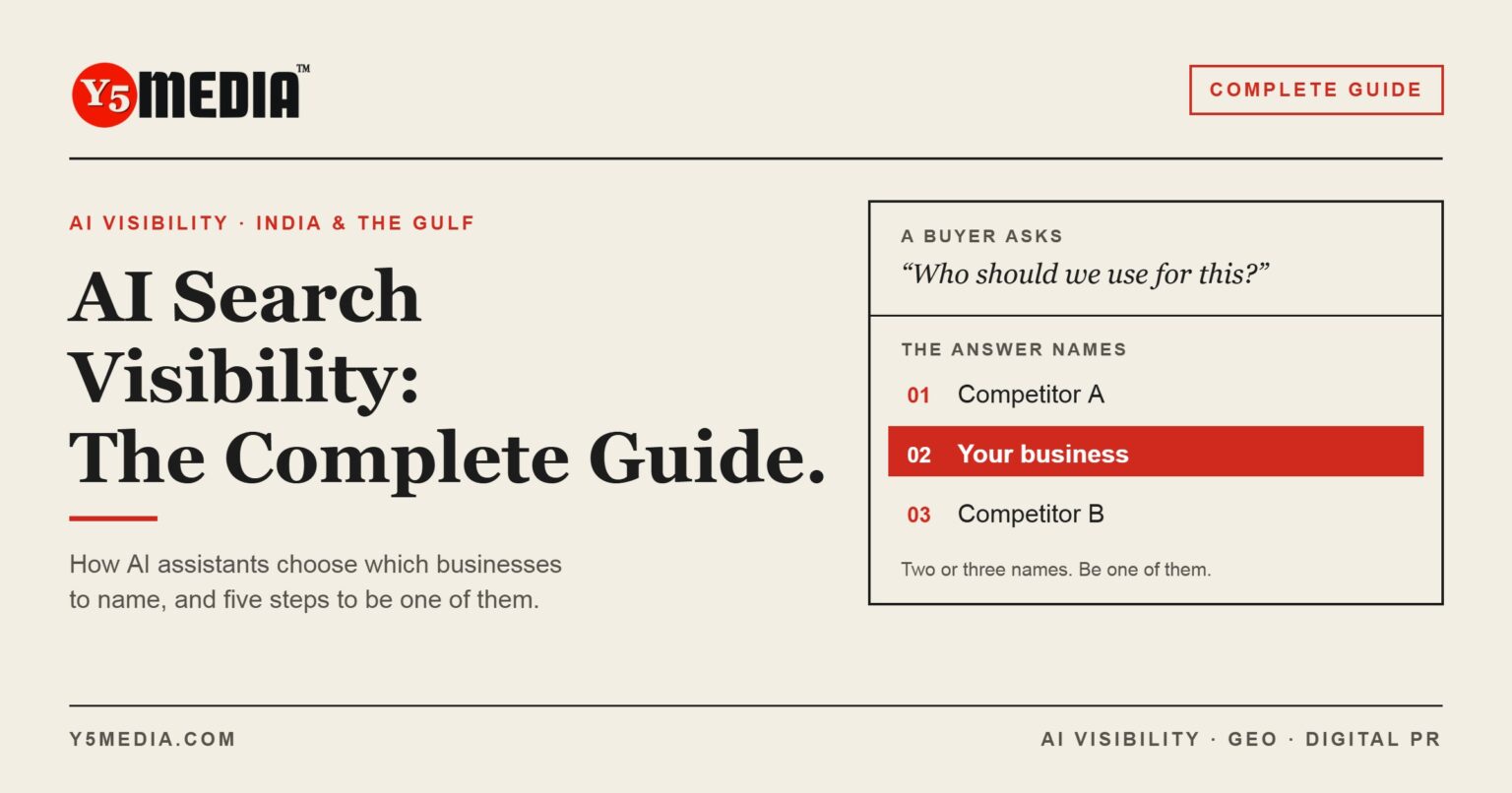
Buyers now ask ChatGPT, Gemini, Perplexity and Google’s AI Overviews who to hire, and the answer usually names just two or three businesses. AI search visibility is the work of making sure yours is one of them, and that it is described accurately.
This guide sets out how AI assistants decide which businesses to name, and the five steps we use to improve a brand’s position in those answers. It is written for education groups, healthcare providers, real estate developers and B2B service firms in India and the Gulf, but the method applies to any business that is chosen after a search.
What AI Search Visibility Means
AI search visibility is how often, and how accurately, AI assistants mention your business when someone asks a question you should be the answer to. It is sometimes called GEO (generative engine optimization) or AEO (answer engine optimization).
It builds on SEO rather than replacing it. The difference is in what gets rewarded:
| Conventional SEO | AI search visibility | |
|---|---|---|
| Result | A ranked list of links | A written answer naming a few businesses |
| Success looks like | Ranking on page one | Being named, and described correctly |
| What counts most | Your pages, links to them, technical health | Your pages plus what others say about you |
| Where it is measured | Search Console, rank trackers | Repeated tests of buyer questions across AI tools |
Rankings still matter, because many AI tools draw on search results. But a business can rank well and still be missing from AI answers if the wider web does not confirm what its website claims.
How AI Assistants Decide Which Businesses to Name
An AI answer is assembled from evidence. When a buyer asks “Which school ERP provider should we use in Karnataka?”, the assistant draws on what it learned in training and, increasingly, on live web results. It then names the businesses that the evidence supports most clearly.
That evidence comes from four places:
- Your website. Clear statements of what you do, for whom and where, in pages a machine can parse: clean structure, schema markup and fast loading.
- The public record. Business listings, directory profiles, LinkedIn, Google Business Profile and other entity data. Consistency matters: the same name, location, services and founding year everywhere.
- Coverage. Articles, interviews and mentions on news sites and industry portals. These are independent sources, so they carry more weight than your own claims.
- Reputation. Reviews, testimonials, case studies and references that confirm you deliver what you say.
When all four agree, an assistant can describe you confidently. When they are thin or contradict each other, it tends to name a competitor with a clearer record, or describe you wrongly.
Why It Matters Now for India and Gulf Businesses
- Shortlists are formed before you hear about them. A procurement manager in Dubai or a parent in Mangaluru may ask an AI assistant first and contact only the names it gives. If you are not named, the enquiry never reaches you, and no analytics report shows the loss.
- Many strong local businesses have a weak public record. Firms with decades of good work often have outdated listings, few independent mentions and little structured data. Their reputation lives offline, where AI tools cannot see it.
- Cross-border businesses are easily misdescribed. A company operating in India and the Gulf may appear with the wrong location, an old name or a partial list of services, because different sources say different things.
The upside is that many competitors have not started. Clear, consistent evidence published now has room to stand out.
Step 1: Baseline What AI Says About You Today
Before changing anything, record where you stand. Without a baseline, there is no honest way to show progress later.
- List 15–25 buyer questions. Write them the way a real buyer would ask, not as keywords. Mix category questions (“best school ERP for CBSE schools in India”), comparison questions and direct questions (“Is [your company] reliable?”).
- Ask them in several assistants. At minimum ChatGPT, Gemini, Perplexity and Google with AI Overviews. Use a logged-out or fresh session where possible, and note the date.
- Record three things for each answer: whether you are named, whether the description is accurate, and which competitors are named instead.
- Collect the sources. Where an assistant cites links, save them. They show which sites currently shape the answer about your category.
The result is a simple table of questions against assistants. It usually reveals a pattern: missing entirely, named but described wrongly, or named only for direct questions about your brand. Our article What AI Assistants Say About Your Business – and How to Improve It walks through this test in detail.
Step 2: Make Your Website Machine-Readable
Your website is the one source you fully control, so it should state the facts plainly enough that a machine cannot misread them.
- Say what you do, for whom and where, in one sentence near the top of key pages. A plain statement of service, audience and location is quotable. A slogan is not.
- Write answer-first pages. Put the direct answer to a buyer question in the first one or two sentences, then the detail. AI tools quote answers, not introductions.
- Add structured data. Use Organization or LocalBusiness, Service, FAQPage, Article and BreadcrumbList schema where they genuinely apply. Keep a single, consistent Organization record across the site.
- Give every service its own page, with its own heading, description, process and proof.
- Show real evidence on the page. Case studies with named clients where permitted, figures with dates, and client quotes.
- Keep it fast and crawlable. Slow, script-heavy pages are harder for crawlers to read. Check that robots.txt does not block the AI crawlers you want to be read by.
For a deeper checklist, see GEO Checklist: How to Get Your Business Cited in AI Answers.
Step 3: Fix the Public Record
AI tools cross-check your website against what the rest of the web says about you. This step makes those sources agree.
- Google Business Profile. Verified, with the correct name, category, address, hours, service areas and photos. Keep one profile per real office.
- Business directories and listings. Choose the ones that matter in your sector and region, such as Justdial and IndiaMART in India, sector portals, and B2B review sites like Clutch or GoodFirms for agencies. Correct or close outdated ones.
- LinkedIn company page and founder profiles. The same description, founding year and services as your website.
- Official registrations. Where they are public, make sure the names and addresses match how you describe yourself.
- Knowledge bases. Where you genuinely qualify, a Wikidata entry or a Crunchbase profile helps machines connect the facts about you.
The test is simple: search your brand name and read the first two pages of results. If a stranger would come away with a different picture from the one on your website, the record needs work.
Step 4: Earn Third-Party Evidence
What others publish about you carries more weight than what you say about yourself. Both readers and AI tools treat independent sources as stronger proof.
- Earned coverage. Stories, expert comments and interviews on news sites and industry portals. Focus on real news: a new service, a notable project, data you have gathered, or a clear opinion on a trend in your sector.
- Reviews from real clients. On your Google Business Profile and the review sites your buyers use. Ask consistently after successful projects, and reply to every review.
- Case studies with permission to name. A case study that names the client, with their quote, is far stronger evidence than an anonymous one.
- Partner and association listings. Industry bodies, chambers of commerce, technology partner directories and event speaker pages.
Keep paid and editorial coverage clearly apart. Paid placements can raise awareness, but disguised advertising undermines trust. Our guide Digital PR for Small Businesses covers pitching and story angles in detail.
Step 5: Measure Share of Answers
AI answers change from day to day and from person to person, so a single test proves little. Measure the trend instead.
- Re-run the baseline questions monthly, in the same assistants, in the same way.
- Track share of answers: the percentage of questions where you are named. Track accuracy separately: of the answers that name you, how many describe you correctly.
- Watch which competitors appear. If one name keeps appearing, study its public record. It usually shows which sources the assistants trust in your category.
- Connect it to enquiries. Ask new leads how they found you, and add “an AI assistant” as an option in your enquiry form.
Expect gradual movement. Website fixes can show up within weeks; public-record and coverage work usually takes a few months to be reflected consistently.
AI Visibility by Sector
The method is the same everywhere, but the questions buyers ask, and the sources that matter, differ by sector.
| Sector | Typical buyer question | Evidence that matters most |
|---|---|---|
| Education | “Best CBSE schools near Mangaluru” | Accurate local listings, admissions information, results, parent reviews, coverage of school events |
| Healthcare | “Good orthopaedic clinic in Dubai” | Doctor profiles and qualifications, accurate clinic details, patient reviews, medically accurate content |
| Real estate | “Reliable developers in Mangaluru” | Delivery track record, RERA details, project pages, news coverage, buyer reviews |
| B2B services | “IT outsourcing partner for a Gulf SME” | Service pages, named case studies, client testimonials, industry portal mentions, founder profiles |
In healthcare in particular, accuracy matters more than volume. A clinic described with the wrong specialities or outdated doctors loses trust faster than one that is simply less visible.
Common Mistakes, and What No One Can Promise
- Treating it as a one-off fix rather than a record that needs regular upkeep.
- Publishing large volumes of thin AI-written content. It rarely earns citations and can dilute a site’s credibility.
- Inconsistent names and details across the website, listings and social profiles.
- Chasing a single test result instead of measuring the trend over months.
- Relying only on your own website, with no independent sources to back it up.
No agency controls what ChatGPT, Gemini or Google’s AI says. Anyone guaranteeing that an assistant will name your business, or remove an accurate negative mention, is promising something they cannot deliver. What good work can do is make the accurate record about you clearer, more consistent and easier to find, which makes it more likely to be used.
Frequently Asked Questions
Is AI search visibility the same as SEO?
No, but they overlap. SEO improves where your pages rank. AI search visibility also covers the wider evidence about your business, such as listings, coverage and reviews, because AI answers draw on all of it.
How long does it take to see results?
Website fixes can show up within weeks. Changes to the public record and new coverage usually take a few months to appear consistently across assistants.
Do I need to be on Wikipedia?
No. Most businesses do not qualify for Wikipedia, and attempts to force an entry usually fail. Consistent listings, a strong website and independent coverage matter more.
Which AI assistants should I track?
Start with ChatGPT, Gemini, Perplexity and Google’s AI Overviews, since these are the ones most buyers use. Add others your customers mention.
Can I do this myself?
Yes. The baseline, website and listings steps are manageable in-house with time and care. Earned coverage and ongoing measurement are where specialist help usually saves the most time.
Can you guarantee that ChatGPT will name my business?
No, and you should be wary of anyone who does. We can improve the evidence AI tools rely on and measure the effect honestly.
Go Deeper on Each Step
- What AI Assistants Say About Your Business – and How to Improve It: running your own baseline test.
- GEO Checklist: How to Get Your Business Cited in AI Answers: the website and content checklist.
- Zero-Click Searches: How to Stay Visible When Google Answers for You: visibility when fewer searches end in a click.
- Digital PR for Small Businesses: How to Earn Coverage That Builds Visibility: earning independent evidence.
How Y5MEDIA Approaches This
Our AI Visibility Management service starts by testing what AI tools say about your business today, then works through the checklist above in order of impact: access and indexing, entity consistency, answer-first content and earned mentions. We report what changes every month, and we do not promise rankings or citations no one can control.
AI Visibility Management
Audit what AI says about your brand, fix the gaps and track your share of answers.
Learn more →Generative Engine Optimization
Become the source AI engines choose to quote.
Learn more →Answer Engine Optimization
Answer-first pages that resolve your buyers’ questions.
Learn more →Find Out What AI Says About Your Business
We will check how ChatGPT, Gemini and Google’s AI answers describe your business, who they name instead and where the opening is. Free, with no obligation.
Call or WhatsApp +91 7902024242, email support@y5media.com, or use the contact page.