
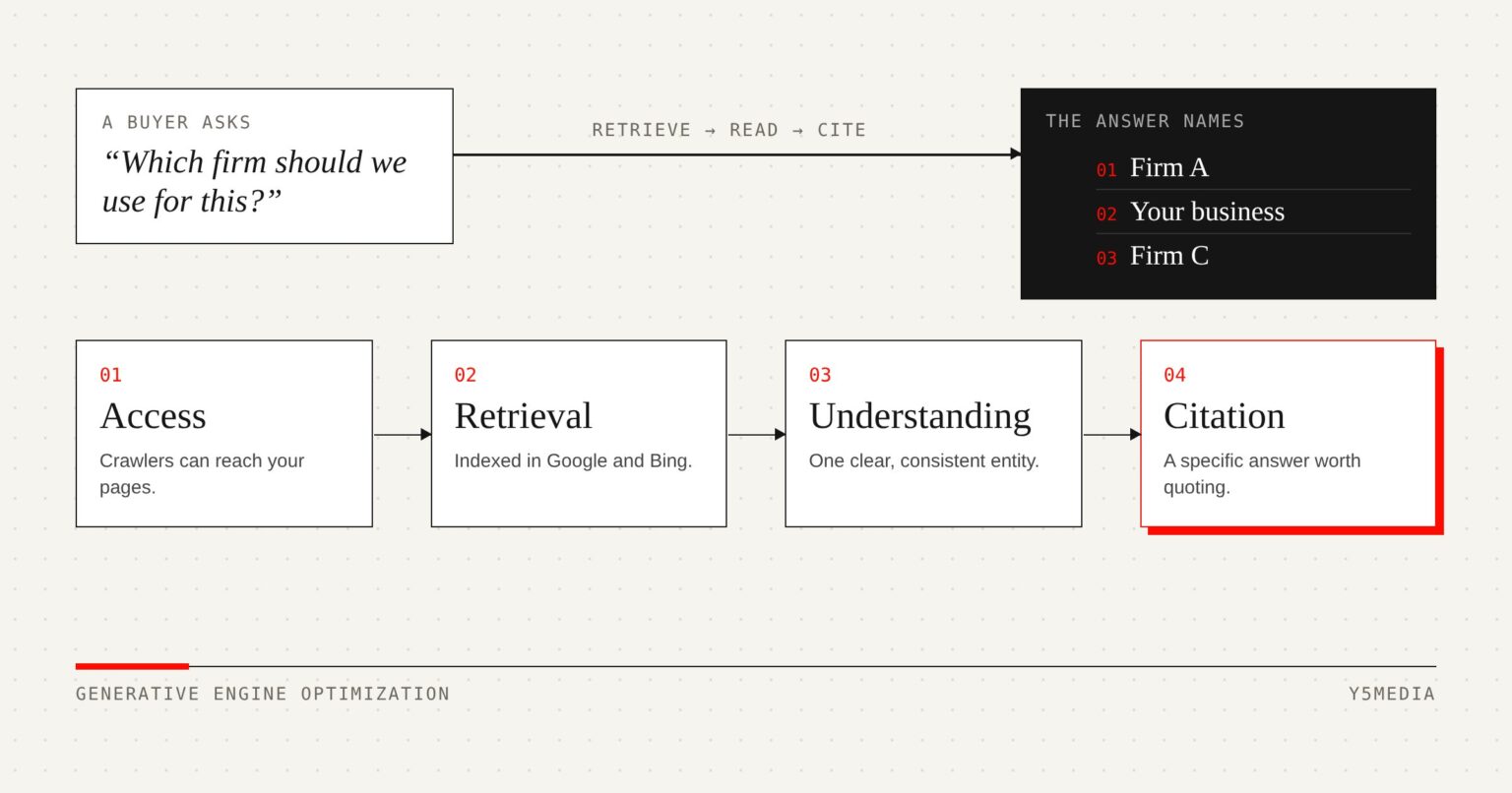
A buyer asks an AI assistant, “Which firm should we use for this?” The answer names two or three businesses, each with a sentence explaining why. Nobody scrolls to page two, because there is no page two. If your business is not among the names, you were never in the running.
Generative engine optimization (GEO) is the work of making your business easy for AI engines such as ChatGPT, Gemini, Google’s AI answers and Perplexity to find, understand and cite. This checklist sets out what that work involves, in the order we would do it, and what nobody can honestly promise you along the way.
How AI Engines Decide What to Cite
Most AI search tools work in two steps. First they retrieve: they search an index of the web, much as a search engine does, and pull back pages that look relevant to the question. Then they generate: they read those pages and write an answer, often with links to the sources they relied on.
That gives you two jobs. Your pages have to be retrievable, meaning crawlable, indexed and relevant to the question. And they have to be quotable, meaning they contain a clear, specific, trustworthy statement the engine can lift and attribute to you.
| Stage | What the engine needs | What usually goes wrong |
|---|---|---|
| Access | To reach your pages without being blocked. | Bot protection, robots.txt rules or slow servers that turn crawlers away. |
| Retrieval | Your pages in the search indexes it draws on. | Pages missing from Bing or Google, so they never reach the shortlist. |
| Understanding | To know exactly who you are and what you do. | Vague service pages and inconsistent business details across the web. |
| Citation | A clear answer it can quote, from a source it trusts. | Answers buried in long paragraphs, and no independent sources confirming them. |
The GEO Checklist
1. Make sure AI crawlers can actually reach you
Start with access, because nothing else matters if crawlers are turned away. Check that robots.txt does not block the search and AI crawlers you want, and ask your host whether bot protection is challenging them. A firewall that serves a challenge page instead of your content looks fine to human visitors and blank to a crawler.
- Review robots.txt for rules that block search or AI crawlers.
- Ask your host to allow verified search and AI crawlers and to never challenge robots.txt, sitemaps or static files.
- Run a test such as Google PageSpeed Insights and look for errors that only appear for automated visitors.
2. Get indexed in both Google and Bing
AI tools retrieve from search indexes, and not all of them use Google’s. Bing’s index feeds Microsoft Copilot and is widely reported to be one of the sources behind ChatGPT’s search. Many businesses have never verified their site in Bing Webmaster Tools, which leaves part of the AI answer landscape working from incomplete information.
- Verify your site in Google Search Console and Bing Webmaster Tools.
- Submit your sitemap to both, and submit important new pages for indexing.
- Check the indexing reports for pages that were crawled but never indexed.
3. Make your business an unambiguous entity
AI engines build their understanding from many sources at once. If your website, Google Business Profile, directory listings and social profiles describe you differently, the engine has to guess. Guessing is how a business ends up described with an old address, a discontinued service or a competitor’s phone number.
- Use one business name, address, phone number and description everywhere.
- Add Organization or LocalBusiness structured data, with links to your official profiles.
- Keep the About page factual: who owns the business, where it operates, what it does and since when.
Our guide to entity-based optimization covers this step in more depth.
4. Write answer-first pages
An AI engine does not want your whole page. It wants the sentence that resolves the question. Put that sentence near the top, in plain language, then support it. A service page that opens with three paragraphs of brand story makes the engine work harder than a page that opens with “We migrate school ERP data to a new system, starting with a written data audit.”
- Open each key page with a one- or two-sentence direct answer.
- Use headings that match how buyers phrase their questions.
- Add a short FAQ to service pages, using questions real customers ask.
5. Be specific enough to be quotable
Generic claims such as “best-in-class solutions” or “a trusted partner” give an engine nothing to cite. Specific, verifiable statements do: what you do, for whom, where, how the work runs and what it does not include. Specificity is also what separates your page from a hundred near-identical competitor pages.
6. Earn mentions on sites the engines already trust
AI answers lean on independent sources. A business that is described consistently in trade publications, industry portals, credible directories and genuine reviews is easier for an engine to recommend than one that only describes itself. This is where digital PR and AI visibility overlap: earned coverage is evidence the engine can cite.
- Get listed accurately on the portals and directories your buyers use.
- Pursue earned coverage with a genuine angle, not paid placements dressed up as news.
- Encourage honest reviews from real customers, and reply to them.
7. Keep facts current
Engines repeat what they find. Outdated prices, old team pages, closed branches and discontinued services keep resurfacing in answers long after you have moved on. Review your key pages and profiles regularly and remove or update anything that is no longer true.
8. Add an llms.txt file, without expecting miracles
An llms.txt file is a short, plain-text guide at the root of your site that lists your most important pages for AI tools. It is a proposed convention rather than an established standard, and the major engines have not confirmed that they rely on it. It is quick to add and does no harm, but treat it as a tidy signpost, not a ranking lever.
9. Measure what AI actually says about you
Ask the questions your buyers ask, in several AI tools, and record the answers each month: whether you are named, how you are described, who is named instead and which sources are cited. Our guide to what AI assistants say about your business explains how to run this test properly.
How to Measure Progress Without Fooling Yourself
AI answers vary from one run to the next, by phrasing, by tool and over time. A single screenshot proves very little. Measure in a way that survives that variation:
- Use a fixed set of buyer questions and run each one several times per tool.
- Track how often you are named and whether the description is accurate, not just whether you appear once.
- Note which sources the engines cite, because those are the pages and sites worth strengthening.
- Use the AI-related reports in Bing Webmaster Tools and your analytics referrals from AI tools as supporting evidence.
What to Ignore
- Guaranteed AI rankings or citations. No one controls what an AI engine says. Anyone promising a guaranteed mention is selling something they cannot deliver.
- Hidden text or prompts aimed at AI. Instructions buried in a page to manipulate AI tools are a trust risk and can backfire.
- Mass-produced AI content. Hundreds of thin pages add noise, not authority. Fewer, better pages work harder.
- Fake reviews or invented case studies. They damage trust with people and with the systems that read about you.
Frequently Asked Questions
Is GEO different from SEO?
It builds on SEO rather than replacing it. SEO gets your pages found and ranked; GEO makes sure the content on those pages is clear, specific and trustworthy enough for an AI engine to quote. A site with weak SEO usually has weak AI visibility too.
How long does GEO take to show results?
Access and indexing fixes can take effect within weeks. Changes in how AI tools describe you depend on how often they refresh their sources and on the independent mentions you earn, so expect months rather than days, and expect it to vary by tool.
Can a small business compete with big brands in AI answers?
Often, yes, for specific questions. AI engines answer narrow, local or specialist questions with sources that address them directly, and a focused small business can be the clearest source on its own niche.
Do I need to block or allow AI crawlers?
That is a business decision. If you want to be recommended in AI answers, the crawlers those tools use for search need to be able to reach your public pages. You can still keep private areas blocked.
What to Remember
- AI engines retrieve from search indexes, then quote what they can understand and trust.
- Access and indexing come first, including Bing, not only Google.
- Consistent business facts and answer-first pages make you easier to cite.
- Independent mentions are evidence AI engines rely on.
- Measure repeatedly over time; ignore anyone who guarantees citations.
How Y5MEDIA Approaches This
Our AI Visibility Management service starts by testing what AI tools say about your business today, then works through the checklist above in order of impact: access and indexing, entity consistency, answer-first content and earned mentions. We report what changes every month, and we do not promise rankings or citations no one can control.
AI Visibility Management
Audit what AI says about your brand, fix the gaps and track your share of answers.
Learn more →Generative Engine Optimization
Become the source AI engines choose to quote.
Learn more →Answer Engine Optimization
Answer-first pages that resolve your buyers’ questions.
Learn more →Find Out What AI Says About Your Business
We will check how ChatGPT, Gemini and Google’s AI answers describe your business, who they name instead and where the opening is. Free, with no obligation.
Call or WhatsApp +91 7902024242, email support@y5media.com, or use the contact page.