
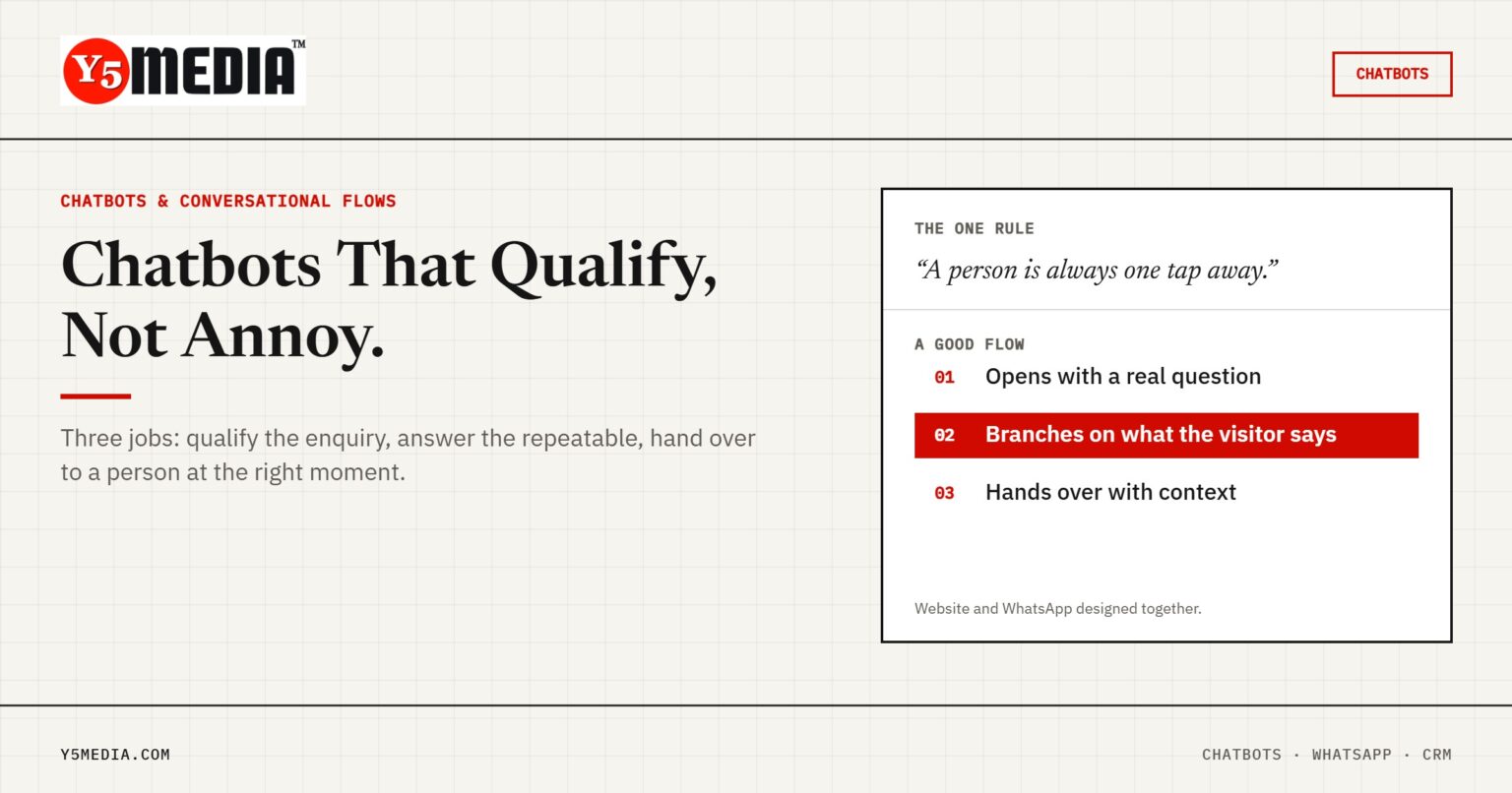
Everyone has been trapped by a chatbot that answers every question with a menu and never offers a human. That experience is a design failure, not a reason to avoid chatbots. A well-designed conversational flow does three things: it qualifies the enquiry, it answers the questions it can answer well, and it hands over to a person the moment it should. Done that way, a chatbot shortens the path to a conversation instead of blocking it.
This article sets out how Y5MEDIA designs conversational flows for websites and WhatsApp, the rules we follow, and where chatbots genuinely pay for themselves.
What a chatbot is good at
- Qualifying. Two or three questions that tell your team what the enquiry is about and who should take it.
- Answering the repeatable. Hours, locations, fees, documents required, how to book, where to find a form.
- Capturing after hours. Taking the enquiry properly at 11 pm with a clear promise of when a person will respond.
- Routing. Admissions to admissions, service to service, a named person for a named territory.
- Booking. Appointments and site visits written straight to a calendar.
What it is bad at
- Complex, emotional or unusual questions.
- Pretending to be human.
- Replacing a sales conversation.
- Anything where a wrong answer has real consequences, such as medical or legal advice.
How Y5MEDIA designs a flow
- Read the real conversations. A month of enquiries from your site, WhatsApp and phone notes, grouped by intent.
- Write for intent, not for menus. The opening question is open; the flow branches on what the visitor says, with a short menu only as a fallback.
- Keep it short. No step that does not change what happens next.
- Plain language, local languages. The flow is written in the languages your customers write in, and reads like a person who is busy but polite.
- Design the hand-off. When, to whom, with what context, and what the visitor is told while they wait.
- Connect it. CRM, sheets, calendar, email, WhatsApp, so an enquiry captured by the bot is a record, not a transcript nobody reads.
- Test and measure. Completion rate, hand-off rate, first-response time, and what happened to the leads, reviewed monthly.
Website, WhatsApp or both?
For most businesses in India and the Gulf, WhatsApp is where the conversation naturally goes, and a website chatbot’s best move is often to offer that channel. We design the two together so a visitor who starts on the site and continues on WhatsApp is not asked the same questions twice.
Frequently Asked Questions
Will a chatbot annoy our customers?
A badly designed one will. A well-designed one qualifies quickly, answers what it can and hands over promptly, with a person always one tap away. Design is the whole difference.
Is it AI or scripted?
Usually a mix: scripted where answers must be exact, AI-assisted for understanding free-text questions, with limits on what the AI may say. For sensitive sectors we keep it scripted.
Can it work in local languages?
Yes. Flows are written in the languages your customers use, and can route by language.
What does it connect to?
CRMs, Google Sheets and Workspace, calendars, email and the WhatsApp Business API, plus custom systems through their APIs.
How is success measured?
First-response time, enquiries captured out of hours, hand-off rate, bookings made, and the outcome of the leads, reported monthly.
Qualify, Answer, Hand Over. In That Order.
Send us a month of your enquiries and we will map the flows worth automating and the ones that should go straight to a person. Email support@y5media.com or message us on WhatsApp.