
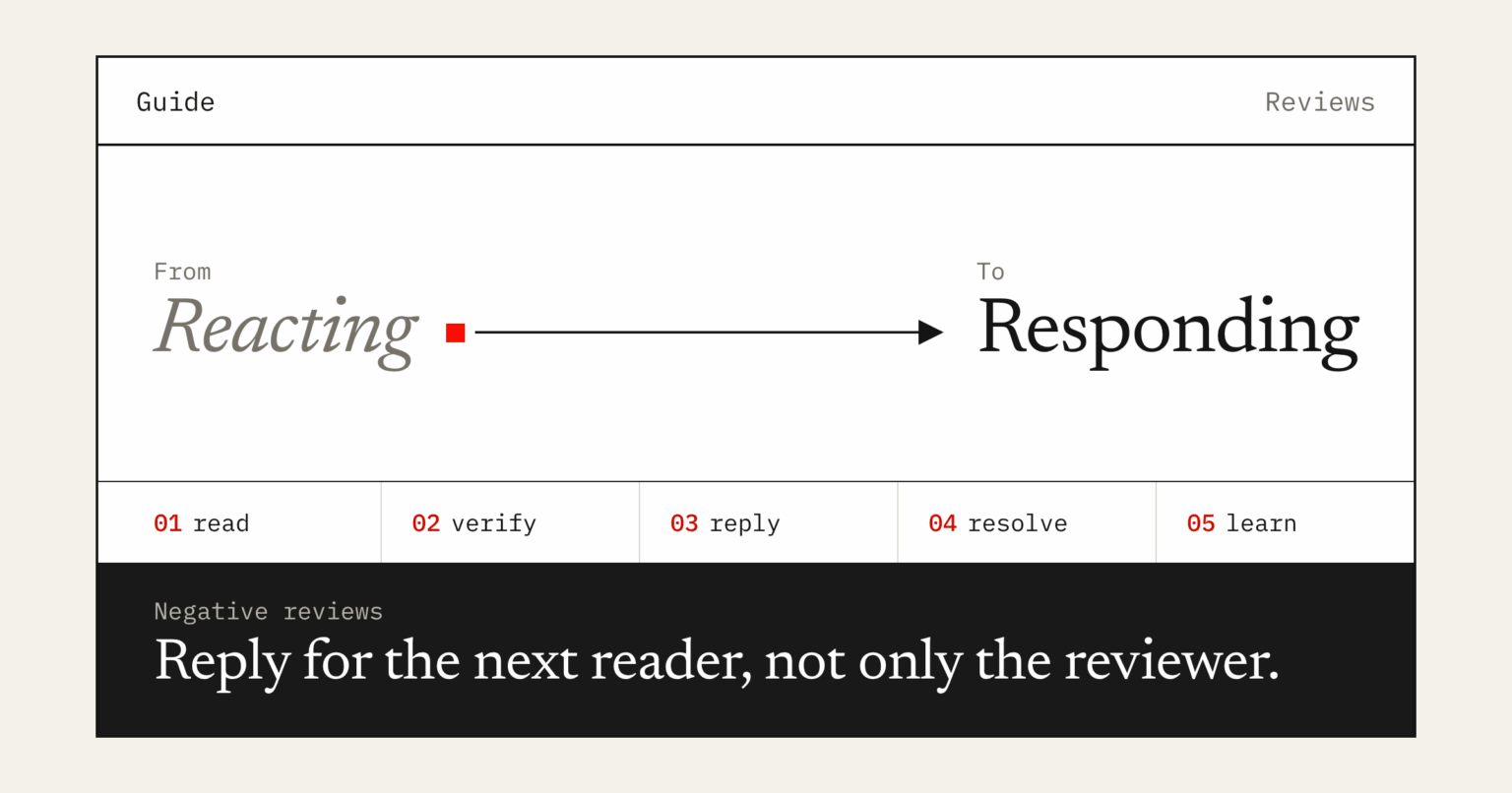
A one-star review arrives on a Tuesday evening. It is unfair in places, accurate in others, and written in capital letters. The owner reads it four times, drafts a reply that would feel wonderful to send, and is about to press the button.
How you respond to negative reviews is read by far more people than the review itself. Future customers are not judging the complaint. They are judging you. This guide explains what to say, what to leave out and when not to reply at all.
Before You Reply
- Wait. Not for days, but until the irritation has passed. A reply written the next morning is nearly always better.
- Check the facts. Find the customer in your records. Establish what actually happened, from your staff as well as the review.
- Decide who replies. One person, with authority to put things right.
The Five Parts of a Good Response
| Part | What it does |
|---|---|
| Thank them | Shows that criticism is taken seriously, not resented. |
| Acknowledge the specific issue | Proves a person read it. Generic replies read as indifference. |
| Apologize where it is warranted | For what went wrong, without excuses. Not for things that did not happen. |
| Say what you are doing | A concrete step, however small. |
| Offer a direct contact | Moves the detail to a private conversation. |
Keep it to four or five sentences. Long replies look defensive, however reasonable each sentence is.
Two Illustrative Examples
These are invented for illustration.
A reply that makes things worse: “We have served thousands of happy customers and this is the first complaint of its kind. You arrived late and were rude to our staff. We will not be spoken to like this.”
A reply that helps: “Thank you for telling us. A forty-minute wait is not the service we want to give, and I am sorry it happened. I have spoken to the team about how Saturday bookings are scheduled. Please call me directly on the number below so that I can put this right.”
The second does not admit to anything untrue. It simply gives the next reader a reason to believe the business cares.
The Privacy Mistake
Never reveal personal details about the customer in a public reply: what they bought, what they were treated for, what they owe, what they said in confidence. This matters most for clinics, schools, financial and legal services, where confirming that someone is a client can itself be a breach. Respond to the concern in general terms and take the specifics offline.
When Not to Reply, or Not in the Usual Way
- Abusive or threatening reviews. Report them through the platform. Do not engage.
- Reviews that are clearly for another business. A short, polite note saying so, and a report to the platform.
- Suspected fake reviews. Flag them using the platform’s process, with any evidence. If you reply, say calmly that you can find no record and invite contact.
- Matters already in dispute. Where lawyers are involved, take advice before saying anything publicly.
Platforms decide what is removed, according to their own policies. A review will not be taken down merely because it is negative, and nobody can guarantee a removal.
What Not to Do
- Do not argue point by point.
- Do not copy the same reply under every review.
- Do not ask friends or staff to post positive reviews to push it down. See why fake reviews backfire.
- Do not offer a refund or a gift in exchange for deleting the review.
- Do not ignore it and hope.
After the Reply
Fix whatever caused the complaint, if it was real. A pattern of similar reviews is free consultancy. If the matter is resolved, the customer may choose to update their review. Do not press them to. For the wider picture, see online reputation management for business.
Frequently Asked Questions
Should every negative review get a reply?
Genuine ones, yes, and reasonably promptly. A brief, calm reply is better than silence.
How quickly should we respond?
Within a day or two. Quick enough to show attention, slow enough to have checked the facts.
Can we have a negative review removed?
Only if it breaks the platform’s rules, and the platform decides. Genuine criticism generally stays.
Should we reply to positive reviews as well?
Yes. A short, specific thank-you shows that all feedback is read, not only the complaints.
What to Remember
- Wait, check the facts, then reply.
- Thank, acknowledge, apologize where due, act, offer contact.
- Keep it short and write for the next reader.
- Never disclose customer details in public.
- Report fake or abusive reviews. Do not fight them with fake ones.
How Y5MEDIA Approaches This
Personal Branding, Reputation Management and Digital PR is a selective Y5MEDIA Premium service for people and organizations acting lawfully and honestly. Reputation work is taken on only where someone is the target of false news, false comments or fake reviews. We do not help anyone suppress genuine criticism. It starts with an assessment of the facts, the scope is agreed in writing, and it does not include guaranteed rankings, removals or media coverage.
Personal Branding and Reputation
A selective Y5MEDIA Premium service for people and organizations whose name matters.
Learn more →AI Visibility Management
How your brand appears in search results and in AI answers.
Learn more →Digital PR Distributions
Announcements and expert content distributed through relevant channels.
Learn more →Reviews Taking Up More Time Than They Should?
Tell us where your reviews appear and what kind of complaints recur. We look at the facts first, and engagements are accepted after a suitability review.
Call or WhatsApp +91 7902024242, email support@y5media.com, or use the contact page.