
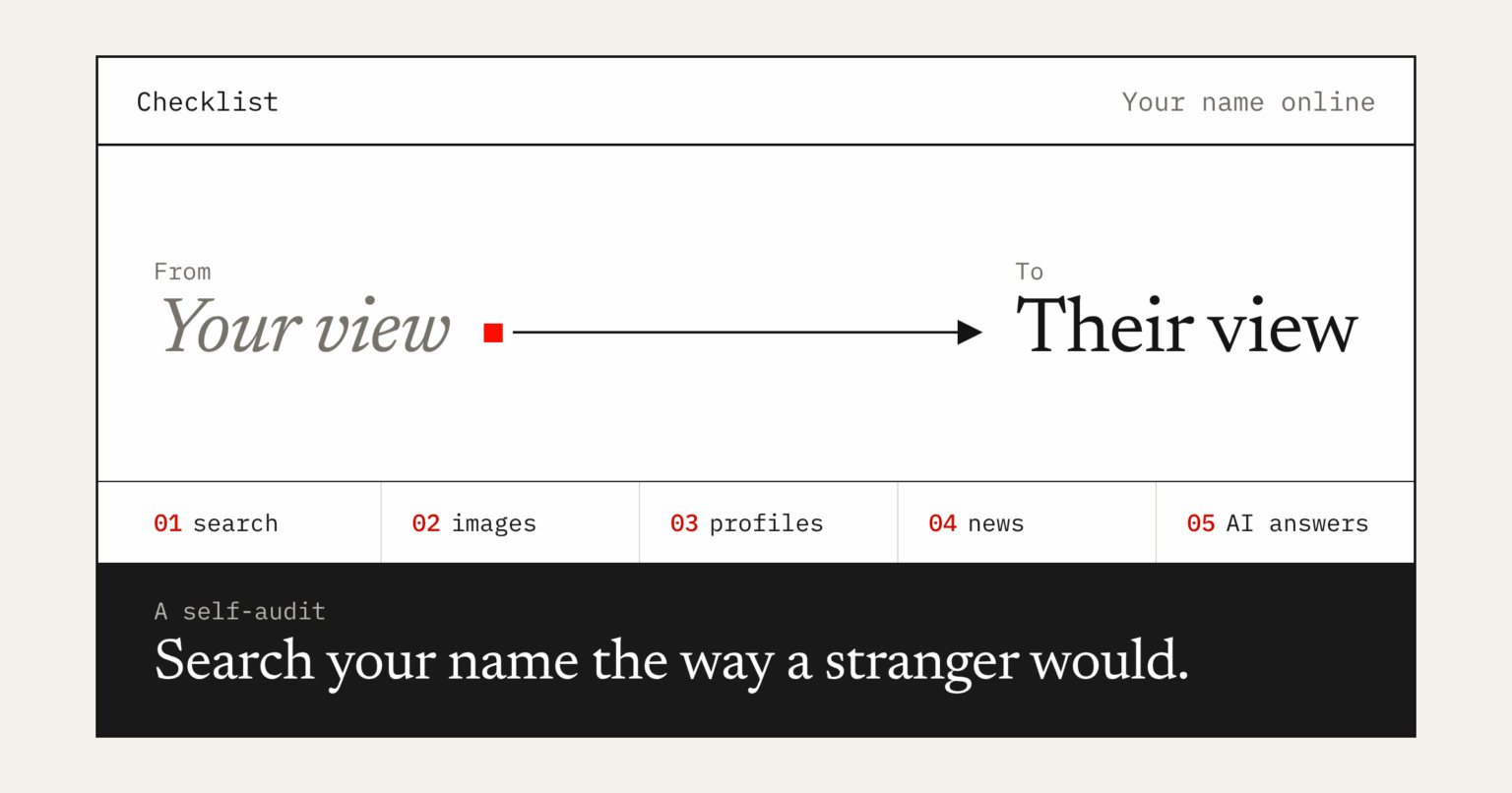
You know what your record is. You do not necessarily know what a stranger sees when they type your name into a search box, because you are the one person who never needs to look. Clients, lenders, journalists, recruiters and prospective partners all do.
A personal online reputation audit takes about an hour and tells you what they find. This guide sets out how to do one properly, how to read the results and what to do about each kind of finding.
Search the Way a Stranger Would
Search engines personalize results. What you see when signed in, from your usual device, is not what others see.
- Use a private or incognito window, signed out of your accounts.
- Search your full name in quotation marks, then without.
- Add your city, your company and your profession, one at a time.
- Try common misspellings and any former names or initials.
- Repeat on a second search engine and on a phone.
Six Places to Look
| Where | What to note |
|---|---|
| Web results | The first two pages. Few people go further. |
| Images | Which photographs appear, and whether they are of you. |
| News | Mentions in the press, recent and old. |
| Social profiles | Including accounts you opened years ago and forgot. |
| Business listings and directories | Old addresses, former employers, incorrect titles. |
| AI assistants | Ask one or two who you are and what you do, and note what they say and get wrong. |
The last of these is new and increasingly matters. Our article on how AI assistants describe your brand explains where their answers come from.
Reading What You Find
Accurate and current
Good. Note which pages these are, since they are the ones to keep updated.
Accurate but out of date
A former role, an old photograph, a company you left. Usually the easiest to fix, because you control the profile or can ask the site’s owner to update it.
Very little at all
More common than people expect. Absence is not neutral. A person who cannot be found at all looks less established than one who can. The remedy is to build a presence, as described in personal branding for founders and professionals.
Someone else with your name
If a namesake dominates the results, consistency becomes more important: a fixed form of your name, your profession and location stated clearly, and a page you control.
Inaccurate
Wrong facts on a site you do not control. Approach the publisher politely, with the correction and evidence. Most will amend a plain factual error.
Negative and true
The hardest category. A genuine complaint, an old report, a legitimate review. These generally cannot and should not be made to disappear. What can change is the context around them. See can negative search results be removed?
Private information exposed
A home address, a personal phone number or identity documents. Treat this as urgent. Platforms and search engines have request processes for certain kinds of personal information, and legal advice may be appropriate.
Keep a Baseline
Record what you found: the search terms, the date and the first ten results for each. Take screenshots. Without a baseline you cannot tell later whether anything has improved, and you will be at the mercy of anyone who claims that it has.
Repeat the audit every three or four months, and after any event likely to prompt searches: a new role, a funding announcement, a dispute, a mention in the press.
What an Audit Cannot Tell You
It shows what is visible today from where you searched. Results differ by location, device and time, and nobody can guarantee what a particular person will see. It is a snapshot, and a useful one, as long as it is treated as that.
Frequently Asked Questions
How often should I search my own name?
Every few months, and after anything that might cause others to look you up.
Why do I see different results from my colleague?
Results are personalized by location, device and search history. A private window reduces this, without removing it.
What if there is nothing negative but nothing much at all?
Then the task is building a presence, which is slower than correcting one and entirely within your control.
Should I ask someone else to do the audit?
A second person often notices what you overlook, and reads the results as a stranger would. Share only what you are comfortable sharing.
What to Remember
- Search signed out, in a private window, with several variations.
- Check web, images, news, profiles, listings and AI assistants.
- Sort findings by kind before acting on any of them.
- Being invisible is a finding too.
- Record a dated baseline and repeat the audit.
How Y5MEDIA Approaches This
Personal Branding, Reputation Management and Digital PR is a selective Y5MEDIA Premium service for people and organizations acting lawfully and honestly. Reputation work is taken on only where someone is the target of false news, false comments or fake reviews. We do not help anyone suppress genuine criticism. It starts with an assessment of the facts, the scope is agreed in writing, and it does not include guaranteed rankings, removals or media coverage.
Personal Branding and Reputation
A selective Y5MEDIA Premium service for people and organizations whose name matters.
Learn more →AI Visibility Management
How your brand appears in search results and in AI answers.
Learn more →Digital PR Distributions
Announcements and expert content distributed through relevant channels.
Learn more →Not Sure What People Find When They Search for You?
Tell us the name or organization you are concerned about. We start with the facts as they appear today, and engagements are accepted after a suitability review.
Call or WhatsApp +91 7902024242, email support@y5media.com, or use the contact page.